


In the vast digital savannah where data roams like wild herds, a new kind of identity is emerging—not one chained to centralized gatekeepers, but one that moves freely, untamed and self-owned. This is the realm of Self-Sovereign Identity (SSI), a paradigm shift that redefines how we prove who we are, what we know, and what we can do. And at the heart of this transformation lies the burgeoning world of micro-credentials—digital badges of mastery that are as portable as a bird in flight and as verifiable as a fingerprint. Together, SSI and micro-credentials are not just reshaping education and professional validation; they are reimagining trust itself.
Imagine a world where your skills are not locked in a dusty filing cabinet of a university registrar or buried in the cryptic depths of a corporate HR database. Instead, they live in a digital wallet, a sleek, encrypted vault that you control. Each badge, certificate, or credential is a luminous fragment of your competence—earned through rigorous learning, validated by trusted issuers, and presented with a single tap. This is not a futuristic fantasy. It is the quiet revolution of Self-Sovereign Identity, now breathing life into the granular, ever-evolving landscape of micro-credentials.

The Digital Passport: Why SSI is the Ultimate Credential Carrier
Traditional credentials are like passports stamped by foreign embassies—each one a bureaucratic relic requiring hours of verification, translation, and trust-building. SSI flips this model on its head. Instead of relying on third parties to vouch for you, you become the sovereign authority of your own identity. Your micro-credentials are cryptographically signed digital artifacts, stored in a decentralized identity wallet. When you share them, you don’t hand over a fragile paper certificate; you present a tamper-proof, machine-verifiable token that speaks the universal language of trust.
This shift is not merely technical—it is philosophical. SSI embodies the principle of custodianship: you are not the property of institutions, but the steward of your own digital essence. Micro-credentials, in this context, are not static endorsements but dynamic, updatable reflections of your growth. A course in quantum computing, a workshop on ethical AI, a certification in sustainable agriculture—each becomes a living node in your identity graph, ready to be summoned when needed, yet never surrendered.
Micro-Credentials: The Lego Bricks of a Lifelong Learning Journey
In an era where knowledge half-lives are measured in years, not decades, the monolithic degree is giving way to modular, stackable credentials. Micro-credentials are the Lego bricks of modern education—small, versatile, and infinitely combinable. But without a system to verify their authenticity and portability, they risk becoming digital confetti: pretty to look at, but impossible to assemble into something meaningful.
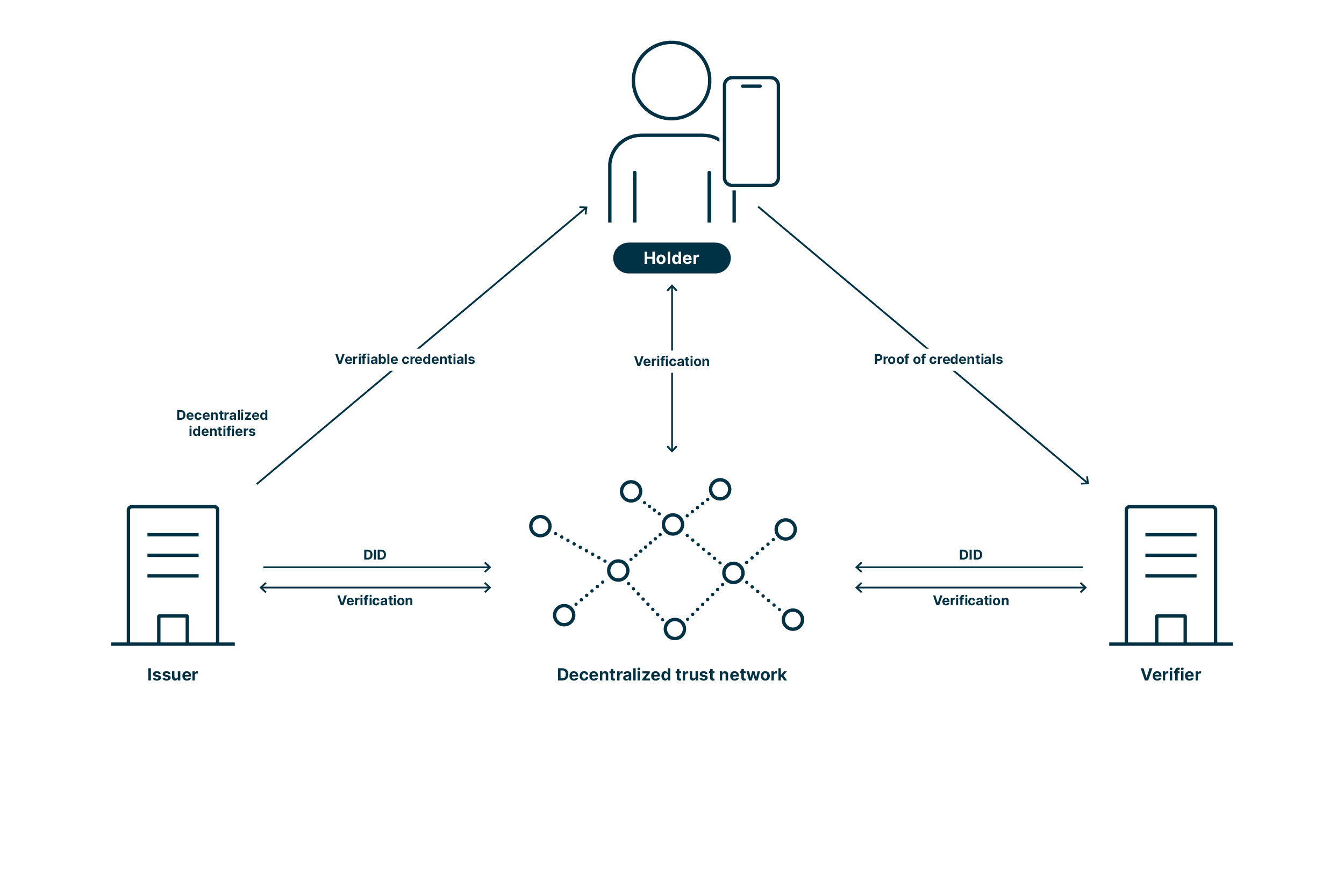
Enter SSI. By anchoring micro-credentials to decentralized identifiers (DIDs), SSI ensures that each badge is not just a claim but a verifiable assertion. Issuers—universities, online platforms, industry consortia—can sign credentials with cryptographic keys, embedding trust directly into the artifact. Learners, in turn, can store these in their identity wallets and selectively disclose them to employers, peers, or platforms without exposing their entire history. It’s like handing someone a single Lego brick from your collection, letting them admire its color and shape, without giving away the entire castle you’ve built.

The Trust Fabric: How SSI Weaves Credibility Without Centralized Gatekeepers
Trust is the invisible thread that stitches society together. In the digital realm, it has historically been managed by intermediaries—registrars, notaries, and platforms that act as gatekeepers of truth. SSI dismantles this hierarchy. Instead of relying on a single source of authority, trust emerges from a distributed network of verifiers and issuers, all bound by cryptographic consensus.
Consider the hiring process. Today, a recruiter might spend days verifying a candidate’s degree, checking for forgeries, contacting alumni networks, and parsing LinkedIn endorsements. With SSI-powered micro-credentials, the process becomes instantaneous. The candidate presents a verifiable credential, the recruiter’s system checks its cryptographic signature against a public registry, and within seconds, the skill is confirmed. No phone calls. No delays. Just pure, frictionless trust.
This is not just efficiency—it is emancipation. It liberates learners from the tyranny of legacy systems that gatekeep micro-credentials behind paywalls, bureaucratic hurdles, or geographic limitations. A student in Nairobi, a professional in Tokyo, a freelancer in Buenos Aires—each can earn, store, and share credentials on equal footing, their achievements no longer confined by the walls of a single institution.
The Privacy Paradox: Sharing Less, Proving More
In a world obsessed with data harvesting, SSI offers a radical alternative: the ability to prove something about yourself without revealing everything about yourself. This is the privacy paradox solved—where minimal disclosure becomes the default, and selective transparency the norm.
Imagine applying for a job that requires “three years of project management experience.” With traditional credentials, you might submit a resume listing every role you’ve ever held. With SSI, you present only the micro-credential that explicitly states your project management proficiency. The employer sees the proof, but not your entire employment history. It’s like showing a bouncer a VIP pass instead of handing over your passport and ID.
This principle extends to lifelong learning. As professionals accumulate skills across platforms, industries, and geographies, their identity wallets become living repositories of growth. Each micro-credential is a chapter in a dynamic narrative—one that can be shared in fragments, tailored to context, and updated in real time. The result? A future where your professional story is not a static document, but a living, breathing entity, controlled by you and validated by the world.
The Future Unfolds: SSI and the Democratization of Opportunity
We stand at the threshold of a new era—one where education is unbounded, credentials are fluid, and identity is sovereign. SSI is not just a tool; it is a movement. A movement toward a world where learning is lifelong, credentials are portable, and trust is decentralized. Micro-credentials, empowered by SSI, are the building blocks of this future—a future where every skill, every achievement, every moment of growth has the potential to be recognized, valued, and leveraged.
This is more than digital innovation. It is a cultural shift. It challenges the notion that authority must be centralized, that trust must be mediated, and that identity must be fragmented. In its place, it offers a vision of autonomy, authenticity, and agency. A world where your digital identity is not a file in a server farm, but a constellation of verifiable truths, orbiting in the vast expanse of the internet—yours to navigate, yours to share, and yours to own.
As this future unfolds, one thing becomes clear: the rise of Self-Sovereign Identity in micro-credentials is not just a technological evolution. It is a revolution in how we define value, measure competence, and build trust. And in that revolution, every learner, every issuer, and every verifier becomes not just a participant—but a pioneer.
Leave a comment