


The Architecture of Recall
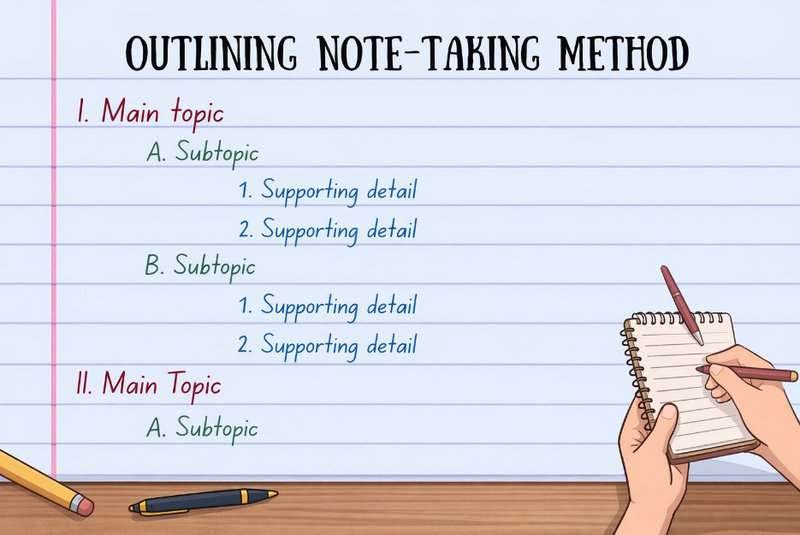
Memory is not a single chamber, but a series of interconnected structures. The most effective note taking methods are those that mirror how the brain naturally builds these connections. Consider the image of a hierarchical outline: main topics anchored on the left, subtopics indented beneath, and supporting details cascading further right. This visual architecture—rooted in association and hierarchy—reinforces neural pathways. When you write notes in an outline format, your brain simultaneously processes two layers: the general concept and its specific components. This dual encoding, known as dual-coding theory, significantly increases the likelihood of retrieval later. The method exploits the fact that memory is relational; isolating facts decreases retention, while linking them to broader categories strengthens the entire network.
The First Pass: Active Encoding
The act of transforming spoken or read information into an outline requires immediate cognitive effort. You cannot simply transcribe verbatim; you must listen, evaluate, and categorize. This process—called active encoding—forces the brain to engage with the material rather than passively record it. When you sketch an outline, you are performing a small act of metacognition: deciding what is primary, what is secondary, and what is merely illustrative. Each decision strengthens the memory trace because it requires you to assign meaning. The outline format also compels you to paraphrase. Paraphrasing is a high-level cognitive skill that converts incoming data into your own mental vocabulary, making it easier to retrieve later. The result is a set of notes that is not a transcript, but a personally meaningful map of the topic.
Hierarchy as a Memory Palace
The outline method effectively creates a text-based memory palace. In classical mnemonic techniques, you mentally walk through a familiar space, placing items at specific locations. The outline replicates this by using visual indentation as spatial cues. The left-most points represent the grand hallways of your memory palace; each indent is a room off the corridor; further indents are shelves within that room. When you need to recall information, your eyes and mind can trace the hierarchy from top to bottom, or from broad to specific. This spatial structure is particularly powerful because the human visual system is evolutionarily attuned to recognize positional patterns. A well-constructed outline allows you to see the entire terrain of a lecture or a book chapter in a single sweep, reducing the mental load of retrieval.

The Spaced Repetition Advantage
Perhaps the most overlooked benefit of the outline method is its natural compatibility with spaced repetition systems. Because outlines are organized with clear hierarchies, you can easily create flashcards or review prompts that follow the same structure. For instance, you might cover the main headings and attempt to recall the subheadings, then cover the subheadings and attempt to recall the supporting details. This layered review mirrors the spacing effect—studying information at increasing intervals for better long-term retention. The outline itself becomes a scaffold for your review schedule: you revisit the top-level concepts daily, the second-level weekly, and the details monthly. Over time, the entire outline becomes effortlessly retrievable, as each review session strengthens the neural networks formed during initial encoding.
Visual Information as a Memory Anchor
A purely textual outline can be enhanced by adding diagrams, sketches, or small images within the hierarchical structure. When you insert a diagram or a relevant icon next to a key point, you are creating a dual route for recall: one verbal, one visual. This is particularly effective for complex subjects like anatomy, engineering, or data structures. The outline method does not need to be entirely textual; you can embed small visual anchors directly in the hierarchy. For example, next to a main heading, you might draw a quick graph or a stick figure representing the concept. The combination of text and image engages multiple brain regions simultaneously, creating a memory trace with redundancy. If the verbal pathway weakens, the visual pathway may still trigger retrieval.

The Cognitive Load Balance
Critics sometimes argue that outlining requires too much mental effort during fast-paced lectures. Yet this cognitive load is precisely what improves memory. Easy note taking methods—like verbatim transcription or bullet lists without hierarchy—produce shallow encoding. The outline method, by contrast, demands that you continuously assess and reorganize incoming information. This active process, while slightly more demanding, keeps the brain in a state of focused attention, inhibiting distractions and reinforcing long-term potentiation. Over time, the technique becomes automatic; you begin to think in outlines even before you write. Eventually, the structure becomes intuitive, and the cognitive overhead decreases dramatically while retention increases. This is the paradox of effective learning: the harder the encoding, the easier the recall.
A Lasting Framework
The outline method is not a novelty or a passing productivity trend. It is a fundamental cognitive tool that mirrors how experts in any field organize their knowledge. A surgeon thinks in hierarchies: systems, organs, tissues, cells. A programmer thinks in hierarchies: programs, modules, functions, variables. A historian thinks in hierarchies: eras, events, causes, consequences. By adopting this method, you are not just recording information; you are training your mind to think in the same structured way that mastery demands. The result is not merely better memory, but deeper understanding. When your notes resemble the mental models of experts, retention becomes almost effortless because the information fits the natural architecture of your thinking.
Leave a comment