


The Quiet Revolution of the Highly Effective
It begins with a simple observation that, once made, becomes impossible to ignore. Walk through any modern office, coffee shop, or co-working space, and you will see them: individuals who glide through their digital environment with a preternatural calm, dispatching tasks with surgical precision while others flounder in a sea of notifications and browser tabs. There is an almost magnetic quality to their workflow, a rhythm that suggests they possess a secret knowledge, a code that unlocks not just greater productivity, but a profound sense of control. The fascination with the tech habits of ultra-productive people is not merely about time management; it is a deeper, almost anthropological curiosity about how they have forged a truce with the very tools that threaten to overwhelm the rest of us.
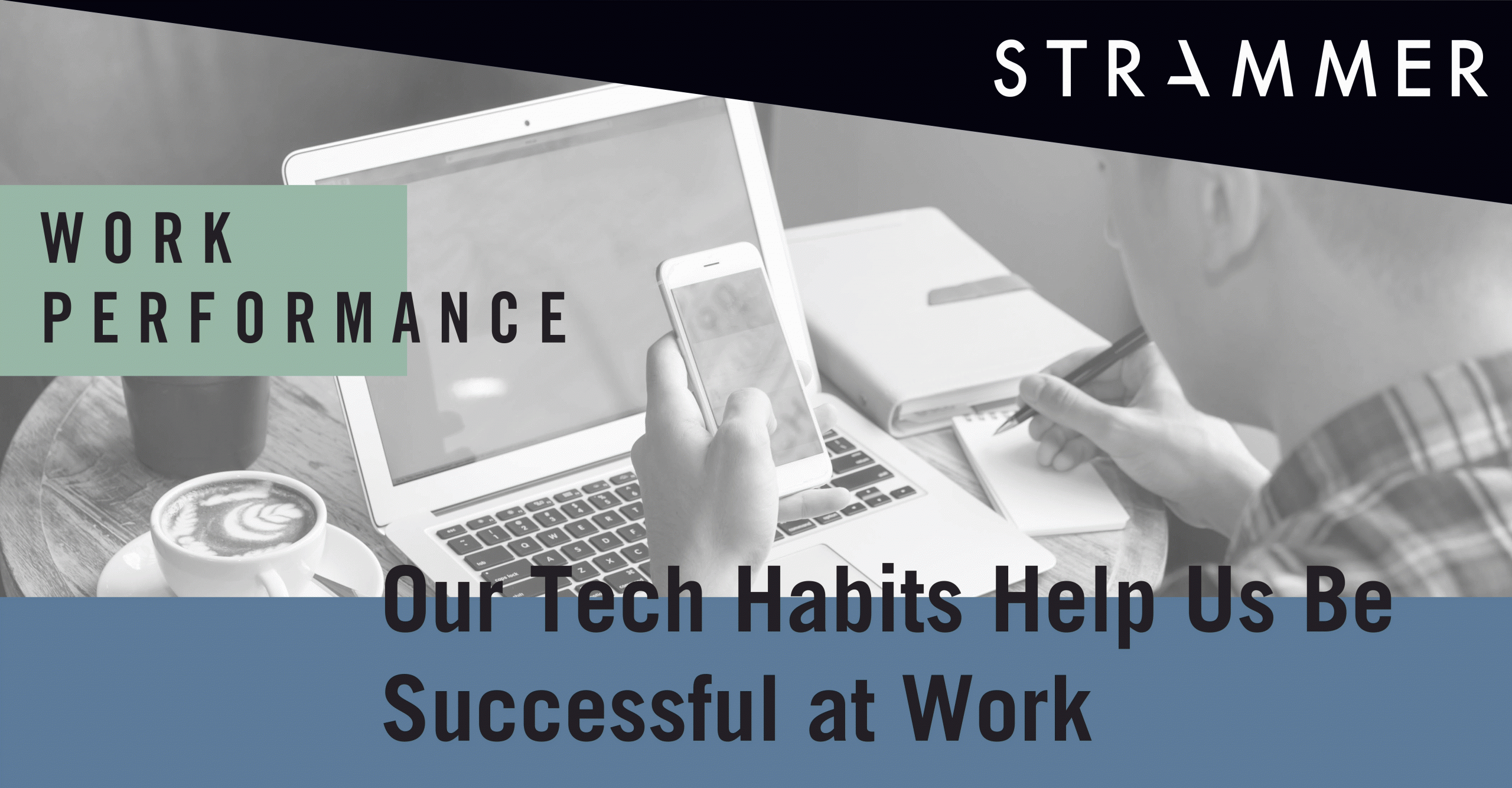
This fascination stems from a fundamental dissonance. We are surrounded by technology that promises efficiency, yet for many, it delivers distraction. The ultra-productive individual, however, has flipped the script. They treat their devices not as masters to be obeyed, but as extensions of their will. Their secret is not a single app or a secret hack, but a philosophy. It is a systematic re-engineering of the relationship between human intention and digital reaction. They have accepted that the tools are neutral; the discipline lies entirely in the user. To understand their habits is to understand a form of modern stoicism, applied not to the unpredictability of the world, but to the predictable onslaught of the inbox.
The Architecture of Intentional Inbox Zero
The first and perhaps most defining trait is their relationship with email. For most, the inbox is a chaotic public square where anyone can interrupt at any time. For the ultra-productive, it is a controlled processing zone. They do not check email reactively. They check it on a schedule, often only three or four times per day. This is not an act of laziness, but of aggressive prioritization. They understand that every ping is a micro-interruption that fragments deep focus, and they guard that focus with the ferocity of a lioness protecting her cubs.
Their method goes beyond simple scheduling. They employ a ruthless triage system known as “Inbox Zero,” but not the naive version that keeps you in your mail client forever. They practice a variant where every email is processed to a single action within seconds. Delete, delegate, respond immediately (if it takes under two minutes), or convert it into a task in a separate, dedicated system. The inbox becomes a transit hub, not a storage unit. This habit fundamentally alters the neurochemistry of work. By removing the background anxiety of unanswered messages, they free up vast amounts of cognitive bandwidth. It is a digital decluttering of the mind, and it is the cornerstone upon which their entire system is built.
The Art of the Single-Tasking Machine
Perhaps the most counterintuitive habit is their absolute rejection of multitasking. In a world that glorifies the juggling act, they understand that human cognition is fundamentally serial. They treat their attention as a laser, not a floodlight. They achieve this by ruthlessly controlling their device’s environment. Notifications are almost entirely disabled. Slack or Teams is set to “Do Not Disturb.” Their phone is face-down, often in another room, or at the very least, in a drawer. This is not anti-social behavior; it is the deliberate creation of a frictionless space for deep work.

This practice is supported by a technique known as “time-boxing.” They block out specific, non-negotiable periods—often 90 to 120 minutes—dedicated to a single, high-value task. During this block, the world disappears. They use apps like the “Pomodoro Technique” timer not as a crutch, but as a regulatory mechanism. They know the brain has a limited supply of willpower and deep concentration each day, and they husband it. They do not check the news. They do not peek at social media. They do not answer the phone. They focus on one thing until it is either done or the time block expires. The result is a quality of output that is simply unattainable by those who are constantly context-switching.
The Deliberate Cultivation of Digital Friction
A more subtle habit is the strategic introduction of friction. The ultra-productive person is a master of making the right thing easy and the wrong thing hard. They remove social media apps from their phone’s home screen, requiring a search to find them. They use browser extensions like “StayFocusd” or “Freedom” to block distracting websites during work hours. They might even use a separate, deliberately slower computer for email and web browsing, while reserving a clean, powerful machine for creation. This seems paradoxical—why would someone so skilled with technology purposefully make it harder to use?
The answer lies in a deep understanding of human psychology. Our brains are wired for the path of least resistance. Willpower is a finite resource that depletes throughout the day. By creating “desirable difficulties,” they outsmart their own impulses. They build a digital environment that forces them to make a deliberate, conscious choice to be distracted. That extra two seconds of friction is often the difference between falling into a rabbit hole and staying on track. This is a form of self-architecture, where the digital space is designed to support the best version of themselves, not the laziest one. They know that their future self will thank their present self for the barriers they built today.

The Philosophy of the Second Brain
Finally, the ultra-productive person has moved beyond the outdated notion of remembering everything. They have embraced the concept of a “Second Brain”—a curated, external system for capturing and organizing ideas. This is not a simple to-do list. It is a personal knowledge management system, often built using tools like Notion, Obsidian, or Roam Research. They are relentless note-takers. Every meeting, every conversation, every interesting article is reduced to its atomic essence and stored in a searchable, linkable digital vault. They don’t trust their memory; they trust their system.
This habit liberates them from the burden of mental clutter. Their mind is free to do the high-level work: synthesis, analysis, and creation. They are not trying to remember a client’s preference from six months ago. They search for it. They are not trying to recall the source of a key insight. They link to it. By offloading the storage function to a trusted digital tool, they dramatically increase their cognitive capacity. This is the final piece of the puzzle. It explains how they seem to have an answer for everything, how they can pivot seamlessly between projects, and how they maintain a disconcerting sense of calm. They have created an externalized mind, one that is always organized, always accessible, and always ready. They have not just mastered their tech habits; they have used them to expand the very architecture of their intelligence.
Leave a comment