


The Architecture of Influence: Building the Cathedral of Dialogue
In the sprawling ecosystem of professional achievement, a quiet truth often goes unspoken: the distance between competence and brilliance is rarely measured in technical skill, but in the invisible architecture of conversation. Top performers do not merely communicate—they construct cathedrals of dialogue with every exchange. Their words are not sounds but structural beams; their silences are not voids but intentional spaces designed to hold weight. Observing them is like watching a master carpenter who never saws against the grain, who knows that the most powerful joints are invisible to the untrained eye. This is not about loudness or verbosity. It is about the ritual precision of shaping meaning before it ever touches air.
Consider the metaphor of a jazz improvisation. The amateur plays notes; the maestro shapes the silence between them. High performers understand that communication is a percussive art—you strike, you listen for the resonance, and then you decide whether to repeat the phrase or change key entirely. They enter every conversation, meeting, or email thread not as transmitters of information, but as architects of a shared experience. The result is not merely understood; it is felt. And in the corporate world, feeling precedes action.

The Ritual of the Pregnant Pause: Unlocking Cognitive Gravity
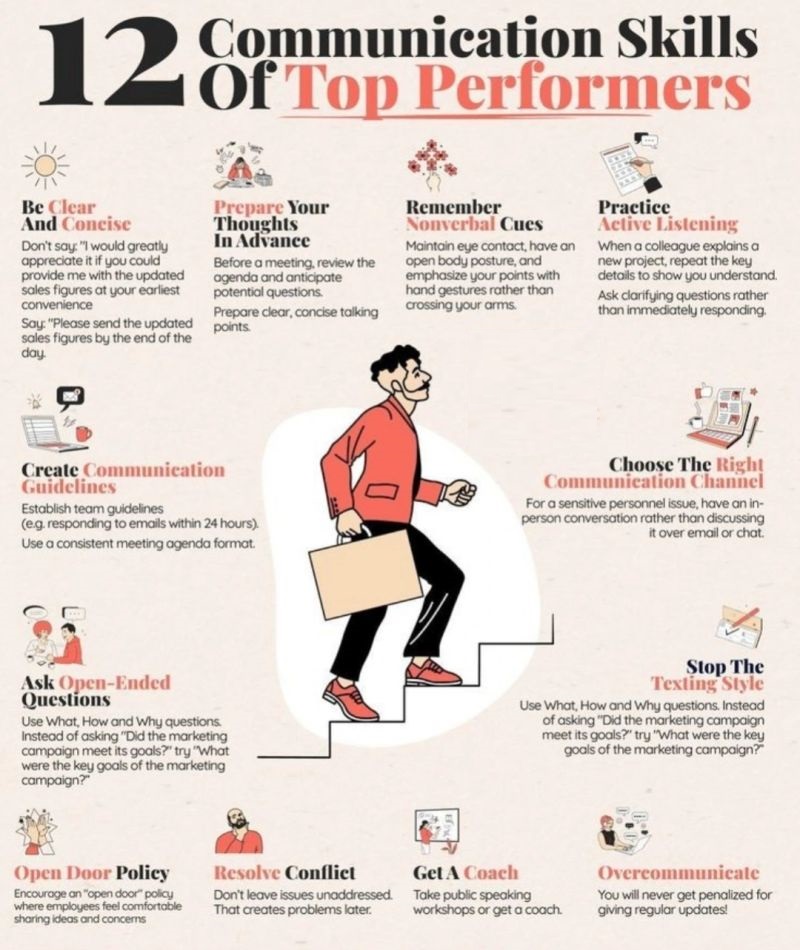
Perhaps the most counterintuitive ritual of top performers is their comfort with silence. In a world addicted to the constant hum of noise, they possess the rare discipline to stop speaking before their point is fully digested. They understand that the human brain processes meaning in waves, not in streams. By leaving a pause—three, five, even ten seconds—after a significant statement, they create a vacuum that compels the listener to lean in. This is not awkwardness; it is cognitive gravity. It pulls the room into the orbit of the idea. The LinkedIn infographic on the 10 Communication Skills of High Performers rarely captures this nuance, but it is the bedrock beneath every bullet point. The pause gives permission for the mind to wander into deeper understanding.
These professionals also master the art of the “verbal hand-off.” They never monologue; they pass the conversational baton with intention. Instead of saying “I need this done,” they reframe it: “What would success look like for you in this project?” The shift is subtle but tectonic. The first is a command; the second is an invitation to co-create. This ritual turns a task into a shared mission, and a subordinate into an invested partner.
Mirroring the Unspoken: The Dashboard of Emotional Data
Top performers treat every conversation as a data stream, but not just of words—of micro-expressions, posture shifts, and vocal timbre. They have trained themselves to read the emotional dashboard of the room as fluently as they read financial reports. When a team member’s voice tightens, they adjust their pitch; when a client’s eyes narrow, they slow their pace. This is not manipulation; it is the thermodynamic efficiency of human connection. They know that the logic of a proposal is useless if the emotional container is cracked.
This is where the ritual of “rephrasing for resonance” becomes crucial. After hearing a key point, they mirror it back, but not verbatim—they distill it to its emotional essence. “So what I hear is that you’re worried about the timeline, but more than that, you’re concerned about the team’s morale.” This simple act validates the speaker while simultaneously elevating the conversation from logistics to leadership. It is a ritual that turns a transaction into trust.

The Choreography of the Concise: Sculpting Time with Words
A fascinating paradox defines the communication rituals of high performers: they are simultaneously the most expansive and the most concise. They speak in parables when explaining vision, but in haiku when delegating action. They have internalized the cost of a meeting minute. Every unnecessary sentence is not just wasted breath—it is currency stolen from someone else’s attention span. The top performer knows that brevity is not about cutting words; it is about preserving impact. They pre-think, pre-structure, and pre-edit before they open their mouth. Their emails are surgical strikes. Their verbal directions are GPS commands: precise, efficient, and leaving no room for ambiguity.
Notice how they never explain that which can be shown, and never show that which can be understood. When faced with a complex problem, they draw a simple diagram on a whiteboard rather than delivering a monologue. Their PowerPoint slides are not data dumps; they are visual haiku that serve as conversation anchors, not crutches. This ritual of “reduction without loss” is the hallmark of someone who respects both the idea and the listener’s time. It is the quiet alchemy of turning noise into signal.
The Feedback Loop as a Living Organism
Finally, the most transformative ritual of top performers is how they frame feedback—not as a correction, but as a calibration. The average professional offers feedback as a judgment; the top performer offers it as a hypothesis. “I noticed this happened; what was your intention there?” This framing dismantles defensiveness and invites collaboration. It treats the conversation as a living organism that must be nurtured, not dissected. They also practice the ancient art of the “pre-mortem”—before a project launches, they ask the team, “Imagine we have failed in six months. What went wrong?” This proactive communication ritual surfaces hidden risks without ever assigning blame. It creates a culture where honesty is the default, not a risk.
In an age of constant digital noise, where Slack pings and email chains create the illusion of connection, these rituals are the lighthouses. They are not just skills—they are disciplines, practiced daily until they become second nature. The high performer does not arrive at success through luck. They build it, brick by vocal brick, pause by pregnant pause, in the sacred cathedral of conversation.
Leave a comment