


What if I told you that the key to solving problems faster isn’t just about working harder or thinking longer—but about thinking smarter? That’s where mental models come in. These cognitive shortcuts aren’t just abstract ideas; they’re practical tools that can transform how you approach challenges, from everyday dilemmas to complex business decisions. But here’s the catch: not all mental models are created equal, and using the wrong one can leave you more confused than when you started. So, how do you harness their power without falling into the trap of overcomplicating things? Let’s break it down.
The Curse of Overthinking: Why Your Brain Needs a Shortcut
Imagine you’re faced with a problem—a big one. Maybe it’s a project at work that’s spiraling out of control, or a personal decision that feels like a maze with no exit. Your first instinct? To dive deep, analyze every angle, and weigh every possible outcome. But here’s the irony: the more you overthink, the more likely you are to get stuck in analysis paralysis. Your brain, brilliant as it is, wasn’t designed to process infinite variables at once.
This is where mental models shine. They’re like the cheat codes of problem-solving—pre-built frameworks that help you cut through the noise and focus on what truly matters. Instead of reinventing the wheel every time you encounter a challenge, you can borrow the wisdom of others who’ve already navigated similar terrain. But not all mental models are useful. Some are too vague, others too rigid, and a few might even lead you astray if misapplied. The trick is knowing which ones to use and when.

The First Rule of Mental Models: Keep It Simple (But Not Too Simple)
One of the most common mistakes people make with mental models is treating them like magic bullets. They assume that adopting a single model—like the Pareto Principle (the 80/20 rule) or Occam’s Razor (the simplest explanation is usually the right one)—will instantly solve all their problems. But mental models aren’t one-size-fits-all solutions. They’re more like tools in a toolbox: useful in the right context, useless in the wrong one.
Take the Pareto Principle, for example. It’s fantastic for identifying the 20% of efforts that yield 80% of results, but it’s not helpful if your problem isn’t about efficiency. Similarly, Occam’s Razor is great for cutting through complexity, but it can lead you astray if the simplest explanation isn’t the correct one. The key is to match the model to the problem, not the other way around.
So, how do you know which model to use? Start by asking yourself: What’s the core issue here? Is it a problem of prioritization? A problem of decision-making? A problem of resource allocation? Once you’ve identified the nature of the challenge, you can select a mental model that aligns with it. And remember: sometimes, the best solution isn’t a single model but a combination of them.
The Second Rule: Context Is Everything
Mental models aren’t universal truths. They’re shaped by the context in which they’re applied. What works in one situation might backfire in another. For example, the concept of second-order thinking—considering the long-term consequences of your actions—is invaluable in strategic planning. But if you’re in a crisis where immediate action is required, second-order thinking might slow you down.
This is why it’s crucial to adapt mental models to your specific circumstances. Don’t just memorize them; understand their underlying principles. Ask yourself: What’s the essence of this model? Is it about trade-offs? About probabilities? About systems? Once you grasp the core idea, you can apply it flexibly, tailoring it to fit the problem at hand.
Let’s say you’re trying to improve your productivity. You might start with the Eisenhower Matrix, which helps you prioritize tasks based on urgency and importance. But what if your real issue isn’t prioritization but focus? In that case, you might layer in the Pomodoro Technique, which breaks work into focused intervals. The combination of these two models can give you a more holistic approach to productivity.
The Third Rule: Avoid the Trap of Dogma
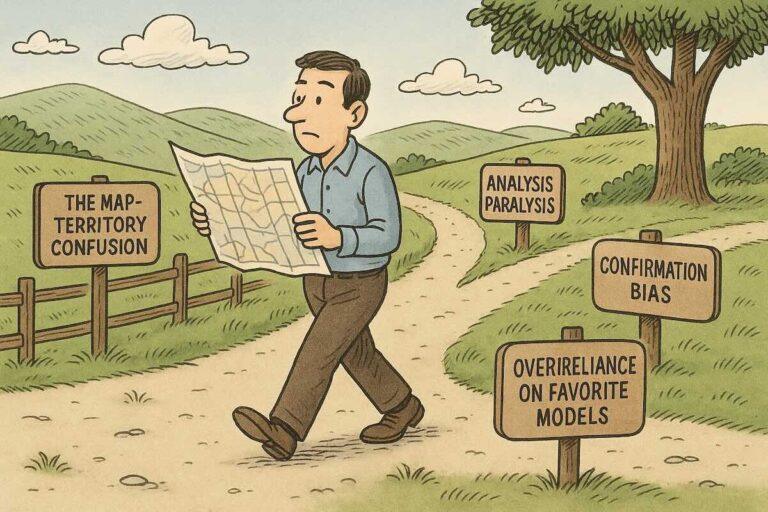
Here’s a harsh truth: mental models can become dogma. People get so attached to a particular model that they start applying it blindly, even when it’s not the right fit. This is especially true for models that sound profound or are popularized by influential figures. The Circle of Competence model, for example, is a powerful tool for understanding your limitations. But if you use it to justify avoiding challenges outside your expertise, you’re missing the point entirely.
The antidote to dogma is skepticism. Always question whether a mental model is serving you or if you’re serving it. Ask yourself: Is this model helping me see the problem more clearly, or is it blinding me to other perspectives? If it’s the latter, it’s time to set it aside and try something else.
Another pitfall is the halo effect, where a single mental model becomes so associated with success that people assume it’s the reason for that success. For example, someone might attribute their business success to the First Principles Thinking model, when in reality, it was a combination of factors, including luck, timing, and execution. Don’t fall into the trap of crediting a single model for your achievements.
Putting It All Together: A Practical Framework for Faster Problem-Solving
So, how do you actually use mental models to solve problems faster? Here’s a step-by-step framework to guide you:
- Define the Problem Clearly: Before you can solve a problem, you need to understand it. Write it down in one sentence. What’s the core issue? What’s the desired outcome?
- Identify the Type of Problem: Is it a decision-making problem, a prioritization problem, a resource allocation problem, or something else? The type of problem will determine which mental models are most relevant.
- Select the Right Models: Based on the problem type, choose 1-3 mental models that align with it. For example, if it’s a prioritization problem, you might use the Eisenhower Matrix and the 80/20 rule.
- Apply the Models Flexibly: Don’t force the models to fit the problem. Adapt them as needed. If a model isn’t working, try a different one.
- Test Your Assumptions: Once you’ve applied the models, ask yourself: Are these assumptions valid? Are there other factors I’m missing?
- Take Action and Iterate: Mental models are tools, not solutions. Use them to guide your actions, but be prepared to adjust as you go.
This framework isn’t rigid. It’s a starting point, a way to bring structure to your problem-solving process without stifling creativity. The goal isn’t to follow it to the letter but to use it as a compass, guiding you toward faster, more effective solutions.
The Final Piece: The Power of Combining Models
One of the most underrated aspects of mental models is their ability to work together. Rarely is a single model enough to solve a complex problem. Instead, it’s the combination of models that unlocks true insight. For example, you might use the Inversion Technique (thinking about how to make things worse) to identify potential pitfalls, then layer in the First Principles Thinking model to break down the problem to its fundamental components. Finally, you might apply the Feedback Loop model to iterate and improve your solution over time.
This is where the real magic happens. By combining models, you create a more robust, nuanced approach to problem-solving. You avoid the blind spots that come with using a single model in isolation. And you gain the flexibility to adapt as new information emerges.
So, the next time you’re faced with a challenge, don’t just think harder—think smarter. Reach for your mental model toolbox, select the right tools, and build a solution that’s as unique as the problem itself. Because the fastest way to solve a problem isn’t to drown in complexity; it’s to navigate it with clarity, precision, and a little bit of playfulness.
Leave a comment