


In the modern workplace, the ability to articulate priorities is often the difference between progress and paralysis. Yet, despite our best intentions, priorities frequently become a source of frustration rather than clarity. Why does this happen? The answer lies not in the complexity of the tasks themselves, but in the way we communicate them. Misaligned priorities breed confusion, wasted effort, and a sense of futility—even when the work being done is meaningful. The key to avoiding this pitfall is not just in setting priorities, but in communicating them with precision, empathy, and intentionality.
The Hidden Cost of Unclear Priorities
When priorities are vague or inconsistently communicated, teams operate in a fog of uncertainty. A 2023 study by the Project Management Institute found that 47% of project failures were directly linked to poor communication of goals. This isn’t just a statistic—it’s a reflection of the daily reality for countless professionals who spend hours on work that later gets deprioritized or discarded.
The deeper issue isn’t laziness or incompetence; it’s the assumption that priorities are self-evident. Leaders often believe that their vision is clear simply because they’ve thought about it deeply. But clarity is not the same as assumption. When priorities are communicated as broad directives—“We need to focus on growth” or “Customer satisfaction is key”—they leave too much room for interpretation. What does “growth” mean? Revenue? Market share? Product innovation? Without specificity, each team member fills in the gaps with their own understanding, leading to misalignment.
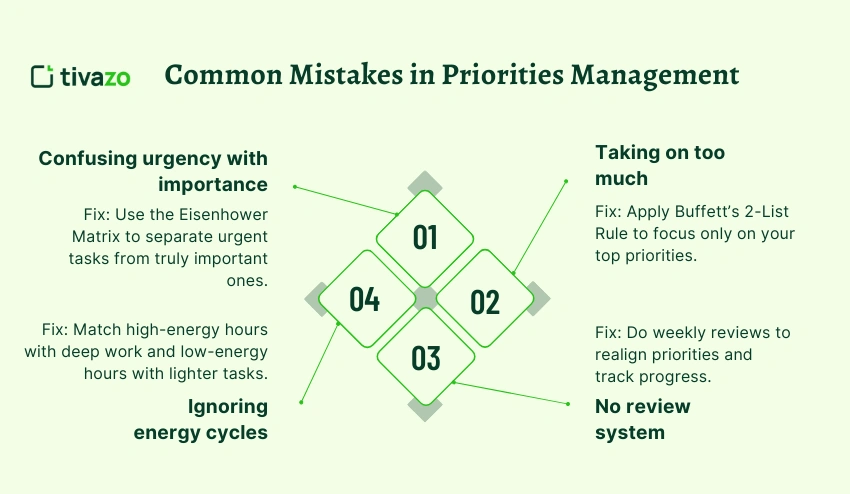
Why We Struggle to Communicate Priorities Effectively
There are three fundamental reasons why even well-intentioned leaders fail to communicate priorities clearly:
1. The Curse of Knowledge
Leaders who have spent months or years immersed in a project often forget what it’s like to see it from the outside. They assume that others understand the context, the urgency, and the trade-offs they’ve already considered. This “curse of knowledge” leads to omissions in communication—details that seem obvious to them but are entirely absent for their teams.
2. The Illusion of Shared Understanding
Even when priorities are discussed in meetings, the illusion of shared understanding can persist. People nod in agreement during a presentation, but when it comes to execution, divergent interpretations emerge. This happens because priorities are rarely revisited in a structured way. A single email or all-hands meeting isn’t enough; priorities need to be reinforced consistently and in context.
3. The Fear of Over-Communication
Some leaders hesitate to over-communicate priorities because they worry about sounding repetitive or micromanaging. But the real risk isn’t over-communication—it’s under-communication. In a world where information is constantly competing for attention, priorities must be repeated to stick. The goal isn’t to say the same thing endlessly, but to ensure that the message is delivered in a way that resonates with different roles and perspectives.
The Framework for Communicating Priorities Without Confusion
Clear communication of priorities isn’t about more meetings or longer emails—it’s about strategy. The following framework breaks down the process into actionable steps:
1. Start with the “Why” Before the “What”
People don’t just need to know what to do; they need to understand why it matters. Simon Sinek’s famous principle—“Start with Why”—applies here. Before listing priorities, articulate the larger goal. For example:
Weak: “Our priority is to improve customer support response times.”
Strong: “We’re prioritizing faster customer support response times because our recent surveys show that 60% of customers abandon purchases when they don’t hear back within 24 hours. This directly impacts our revenue and brand reputation.”
This context transforms a task into a mission, making it easier for teams to internalize the importance of the priority.
2. Use the “Priority Matrix” to Clarify Trade-Offs
Not all priorities are created equal. A priority matrix (also known as an Eisenhower Matrix) helps distinguish between urgent and important tasks. This tool forces leaders to be explicit about what truly matters:
- Urgent and Important: Do these first. Example: A critical bug in a live product.
- Important but Not Urgent: Schedule these. Example: Long-term customer retention strategies.
- Urgent but Not Important: Delegate these. Example: A last-minute request from a client that doesn’t align with strategic goals.
- Neither Urgent nor Important: Eliminate these. Example: Meetings with no clear agenda or outcome.
By sharing this matrix with teams, leaders remove the guesswork about what should take precedence.
3. Communicate Priorities in Context
Priorities shouldn’t exist in a vacuum. They need to be tied to specific outcomes, timelines, and resources. For example:
Vague: “We need to improve team collaboration.”
Contextual: “By Q3, we’re prioritizing the launch of our new collaboration tool to reduce project handoff delays by 30%. This will require each team to dedicate 2 hours per week for training.”
This level of detail ensures that everyone understands not just the priority, but how it fits into the bigger picture.
The Role of Feedback in Refining Priorities
Communication isn’t a one-way street. Even the most clearly articulated priorities can miss the mark if leaders don’t create space for feedback. Teams should feel empowered to ask questions like:
- “How does this priority align with the broader company goals?”
- “What trade-offs are we making by focusing on this?”
- “Are there competing priorities that need to be addressed?”
Leaders who welcome these questions—and respond thoughtfully—build trust and reduce confusion. Feedback loops also reveal blind spots. A priority that seems clear to leadership might be impossible to execute due to resource constraints or conflicting deadlines. Regular check-ins ensure that priorities remain realistic and adaptable.

Common Pitfalls and How to Avoid Them
Even with the best intentions, leaders can fall into traps that undermine clear communication. Here’s how to sidestep them:
1. The “Everything is a Priority” Trap
When every task is labeled a priority, none truly are. Leaders must resist the urge to over-prioritize. Instead, limit the number of top priorities to three to five at any given time. This forces focus and makes it easier for teams to align their efforts.
2. The “Set It and Forget It” Approach
Priorities aren’t static. Market conditions, team dynamics, and business goals evolve. Leaders should revisit priorities regularly—monthly or quarterly—and communicate any changes proactively. A quick Slack message or a five-minute update in a team meeting can prevent misalignment.
3. The “Top-Down Only” Model
Priorities shouldn’t be dictated solely by leadership. Teams closest to the work often have valuable insights into what’s feasible and what’s not. Involving them in the prioritization process increases buy-in and reduces resistance.
Measuring the Impact of Clear Priority Communication
How do you know if your communication is working? Look for these signs:
- Reduced firefighting: Teams spend less time reacting to crises because they’re focused on the right work.
- Higher engagement: Employees feel more connected to the company’s goals and understand their role in achieving them.
- Fewer surprises: Leaders aren’t blindsided by missed deadlines or misaligned efforts because priorities were communicated transparently from the start.
If these indicators aren’t present, it’s time to revisit how priorities are being communicated. The goal isn’t perfection—it’s progress. Even small improvements in clarity can lead to outsized gains in productivity and morale.
Conclusion: The Power of Intentional Communication
Clear communication of priorities isn’t just a managerial skill—it’s a competitive advantage. In a world where attention is a scarce resource, the ability to articulate what truly matters separates high-performing teams from those stuck in a cycle of confusion and inefficiency. It requires effort, empathy, and a willingness to challenge assumptions. But the payoff is worth it: a team that moves in unison, a culture of trust, and work that actually moves the needle.
The next time you set a priority, ask yourself: Would someone outside this room understand why this matters? If the answer isn’t an immediate “yes,” it’s time to refine the message. Because clarity isn’t just about what you say—it’s about what others hear.
Leave a comment