


The Architecture of an Inquiring Mind
In a world that rewards speed over substance, the ability to think critically has become a rare and valuable currency. It’s not merely about being skeptical or argumentative; it is a structured discipline, a routine that sharpens the mind against the dulling effects of bias, misinformation, and cognitive laziness. Building this routine is akin to constructing a mental gymnasium. You don’t walk in and lift the heaviest weight; you practice the form, the repetition, and the deliberate movement. The content of this practice unfolds in three distinct domains: the analysis of information, the interrogation of assumptions, and the synthesis of new perspectives. Each domain offers a specific type of exercise for your cognition, transforming raw data into sturdy, actionable insight.
Information as Raw Material: The Diagnostic Content
The first type of content a critical thinker consumes is diagnostic in nature. This is not passive reading; it is an active interrogation of every claim, statistic, and narrative. When you encounter a news headline, a business report, or even a social media post, the routine demands that you treat it as a patient with symptoms. What is the source of this information? Is it primary or secondary? What is the author’s agenda, and what data points have been omitted? This content forces you to distinguish between correlation and causation, between anecdote and evidence. For instance, a blog post titled “Beyond Numbers: Critical Thinking Sharpens Your Edge” from NFusion Capital provides a perfect specimen for this practice. You do not simply read it; you dissect it. You ask: What specific financial metrics are they discussing? Are they cherry-picking data to support a pre-existing thesis? This diagnostic process turns every piece of information into a training session for your prefrontal cortex, training you to spot logical fallacies like confirmation bias or the bandwagon effect. The content is not there to inform you; it is there to challenge you to verify.
The Assumption Crucible: Deconstructing Internal Narratives
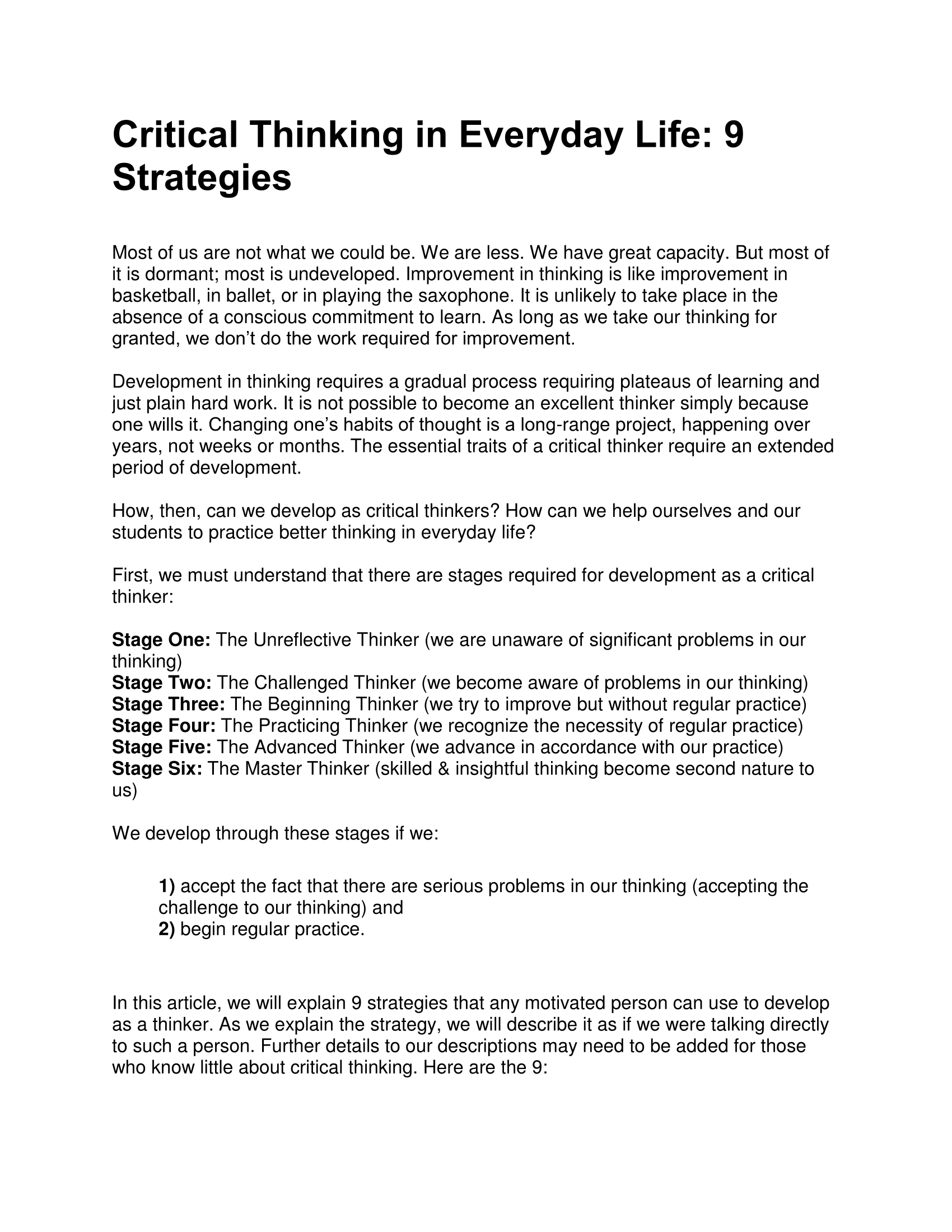
The second, and arguably more uncomfortable, category of content is the one you write yourself—the internal monologue of assumptions. A robust critical thinking routine does not just analyze external data; it turns the lens inward. This is where you engage with content that feels personal, such as your own beliefs, habits, and emotional reactions. You begin to collect examples of your own cognitive shortcuts. Why did you assume that a colleague’s delayed email implies incompetence rather than a heavy workload? Why do you feel a surge of certainty when reading an opinion that aligns with your political views? This self-reflective content is often the most challenging to consume because it threatens your ego. A practical exercise here is to intentionally seek out perspectives that contradict your own—a practice often called “steel-manning” an argument. The image below, from a guide on practical critical thinking, illustrates this process of internal examination, showing a person breaking down a complex problem into manageable logical steps.

This type of content is not about facts; it is about meta-cognition—thinking about your thinking. It requires you to catalog your biases (e.g., availability heuristic, anchoring) and then deliberately challenge them. The routine here is to ask, “What would have to be true for the opposite viewpoint to be valid?” This deconstruction turns your mind into a more flexible instrument, preventing you from becoming a prisoner of your own past experiences.
From Analysis to Synthesis: Creating New Frameworks
The third and final dimension of content in the critical thinking routine is synthetic. Having diagnosed external information and deconstructed internal assumptions, you must now build. This is the content you produce—the new mental models, the integrated understanding, the novel solutions. It bridges the gap between knowing and doing. For example, after critically evaluating the article “For Students” from the criticalthinking.org library, you do not simply memorize its tips. You synthesize its principles with your own experience to create a personal workflow. You develop a checklist for decision-making that incorporates the strengths of each source you’ve studied. You begin to see patterns where others see noise. This synthetic content is often expressed as a written summary, a strategic plan, or a mental map that recombines disparate ideas into a coherent whole. It requires you to move from the specific to the general, from the example to the rule. A true critical thinker does not just collect notes; weaves them into a tapestry of understanding that is stronger than any single thread.
The Sustained Practice: Turning Routine into Reflex
The ultimate aim of this structured approach is to make critical thinking automatic. The routine of diagnosing, deconstructing, and synthesizing is not a one-time project but a lifetime discipline. Initially, it feels slow and laborious. You will catch yourself making assumptions before you stop them. You will struggle to avoid emotional hijack during a heated debate. However, with consistent practice, the routine becomes reflexive. Your mind begins to search for evidence automatically. Your gut reacts to a weak argument not with anger, but with curiosity. The content you consume—whether a scholarly article, a political speech, or a casual conversation—will no longer be a passive stream of information. It will be raw material for the sharpest tool you possess: a mind trained to think for itself.
Leave a comment