


A Curious Fixation on Flow
There is something quietly hypnotic about a Kanban board. Whether it is a physical wall covered in color-coded sticky notes or a sleek digital interface with cards sliding from left to right, the arrangement feels almost instinctually satisfying. We are drawn to it, not merely because it organizes work, but because it promises something deeper: a visible, calm sense of control over chaos. The fascination is not with the cards themselves, but with what they represent — the hidden architecture of how things get done. This method, born on the factory floor of Toyota in the 1940s, has since migrated into software development, marketing, and even personal life management. Yet its core insight remains startlingly simple and profoundly human: limit what you start, and you will finish more.
The Visual Contract: Why Seeing is Believing
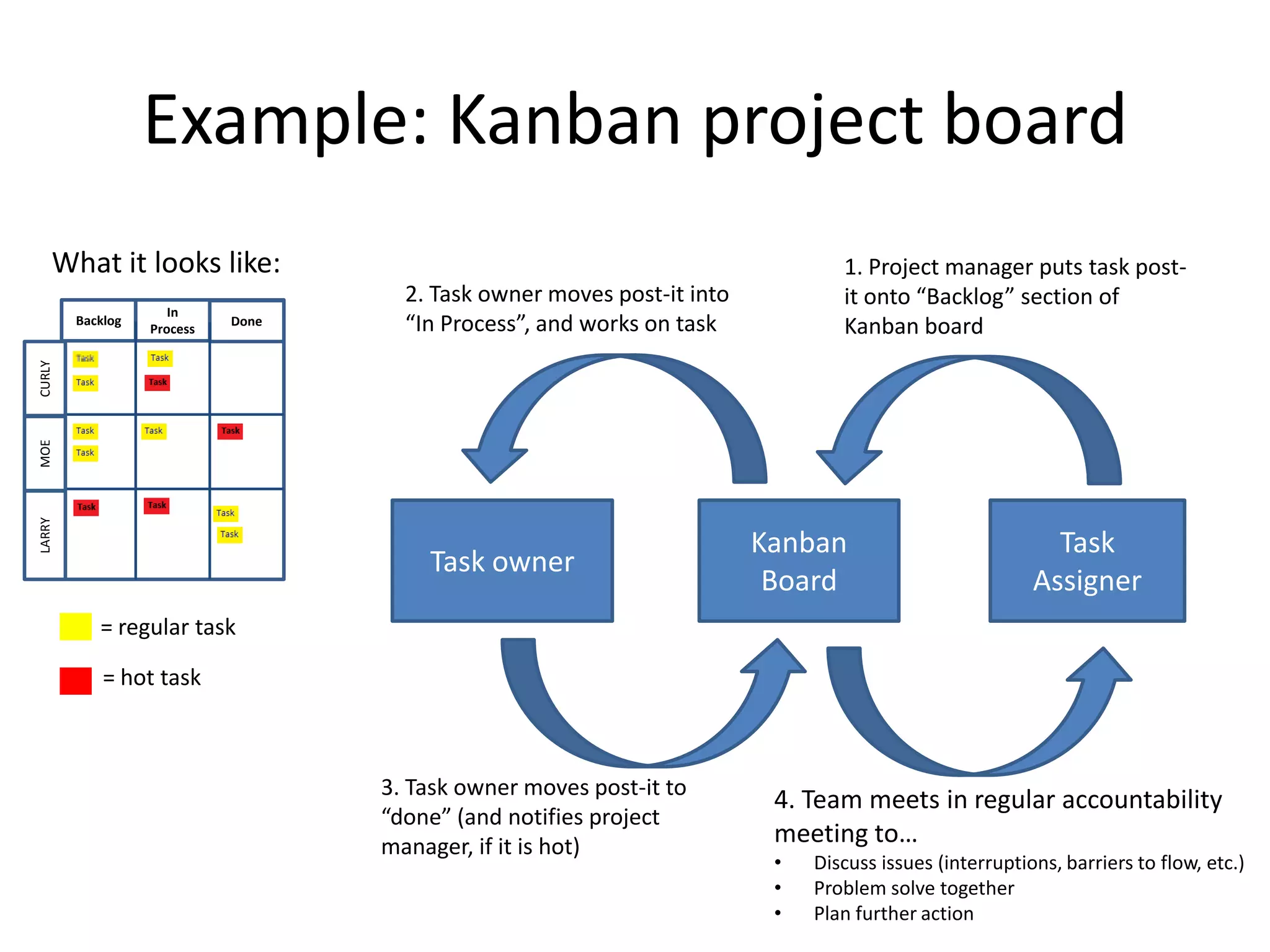
At first glance, the Kanban board appears to be little more than a to-do list broken into columns — typically “To Do,” “In Progress,” and “Done.” But this visual scaffold does something far more powerful than list tasks. It creates a shared reality. In knowledge work, where progress is often invisible and discussions can drift into abstractions, a Kanban board forces transparency. Every card is a promise, a unit of value that someone has committed to delivering. When you look at the board, you are not seeing tasks; you are seeing the flow of attention across a team. The columns are not arbitrary stages; they are the sequential states of value creation. The true power here is not in organization, but in revelation. A board that is honest will immediately show you where work gets stuck, where handoffs grow stale, and where too many cooks are stirring the pot. It is a diagnostic tool disguised as a planner.

The Unspoken Rule: WIP Limits
The signature principle of Kanban — the one that separates it from any other workflow system — is the Work In Progress (WIP) limit. This is not a suggestion; it is a constraint. Each column on your board is assigned a maximum number of cards it can hold at any moment. If “In Progress” is full, nothing new can enter until something else leaves. This runs counter to every instinct in modern productivity culture, where multitasking is worn as a badge of honor and busyness is mistaken for effectiveness. By forcing a bottleneck, Kanban reveals a counterintuitive truth: the fastest way to get more done is to do less at once. Multitasking is not efficiency; it is fragmentation. When a team honors WIP limits, tasks move through the system faster, feedback loops shorten, and quality improves because the mind is not split. The constraint becomes the catalyst.
Measuring the Invisible: Lead Time and Throughput
Once the board is alive and limits are enforced, two metrics become the central nervous system of the method: lead time and throughput. Lead time is the total time from when a request enters the system to when it is delivered. Throughput is the count of items completed in a given period. These measurements are not for micromanagement; they are for prediction. When you accumulate enough data, you can forecast with surprising accuracy how long future work will take. This is the antidote to the classic managerial question “When will it be done?” Rather than guessing based on hope or pressure, a Kanban-informed team points to historical data. The board, over time, transforms from a simple visual aid into a simulation engine for work itself. You begin to see patterns: certain types of tasks always take longer; certain days of the week create drag; some stages of work are consistently slower. With this evidence, improvement becomes surgical rather than aspirational.
The Evolutionary Sweet Spot: Change Without Revolution
One of the most appealing aspects of Kanban is that it does not demand a dramatic overhaul of your existing processes. Unlike many methodologies that require rigid ceremonies, role assignments, or time-boxed sprints, Kanban is explicitly evolutionary. You start with your current workflow exactly as it is, map it visually, and then gradually introduce changes — a small WIP limit here, a new column there. The philosophy is called “Start where you are.” This low barrier to entry makes it psychologically safe for teams that are resistant to upheaval. Change happens organically, driven by data and visible friction rather than by decree. The board becomes a shared experiment, not a mandate. Over weeks and months, the system evolves toward higher efficiency, not because someone forced it, but because everyone saw the evidence.
Beyond the Board: A Philosophy of Pull
Beneath the sticky notes and swimlanes lies a deeper operational philosophy: the principle of pull. Traditional work systems are push-based; work is assigned and forced through the pipeline regardless of capacity. Kanban flips this. Work is only pulled into the next stage when the current stage explicitly requests it and has the capacity to handle it. This creates a rhythm of demand and supply, a kind of heartbeat for the workflow. It prevents overproduction — one of the seven classic wastes in lean thinking — and keeps the system responsive to real needs rather than artificial deadlines. Pull-based systems are inherently adaptive; they absorb uncertainty without breaking. In a world where priorities shift daily and new requests arrive hourly, the ability to let the system’s capacity dictate flow is not just efficient—it is sustainable. The board is merely the body; pull is the soul.

The Quiet Promise of Calm Productivity
The true genius of the Kanban method is not its efficiency, but its humanity. It acknowledges that attention is finite, that context-switching is costly, and that the best way to respect people is to give them clear limits within which they can focus. It replaces the anxiety of “how will we ever finish all this?” with the clarity of “this is what we are doing now.” It does not promise speed; it promises flow. And flow, for both individuals and teams, is the closest thing to peace we can find in a working day. The fascination with those little moving cards is, at its root, a longing for that peace — a visual reminder that work, when properly constrained and made visible, can be not just productive, but almost meditative. In five minutes, you can understand the mechanics. But the depth, as with any great idea, reveals itself over years of practice.
Leave a comment