


Why Your Brain Needs Breaks to Perform Better
There is a peculiar fiction that haunts the modern workplace: the idea that the human mind is a machine. We imagine our neural circuits as conveyor belts, capable of running without interruption as long as the raw material of caffeine and willpower is continuously fed into the hopper. Yet, to hold this belief is to misunderstand the fundamental architecture of thought. The brain is not a steel engine; it is a living forest. And like any forest, it requires not only periods of blazing sunlight but also intervals of twilight and rest to regenerate the soil of insight. If you have ever sat at your desk, staring at a problem that remains stubbornly opaque, you have experienced the precise moment when the forest floor grows barren. The answer is not to push harder. The answer is to step away.
The Anatomy of Cognitive Fatigue
To understand why a break is not a luxury but a biological necessity, we must first grasp the anatomy of attention. Your brain operates on a limited resource known as cognitive fuel—a cocktail of glucose, oxygen, and neurotransmitters like dopamine and norepinephrine. When you concentrate on a single task, you are effectively lighting a fire in a single chamber of your prefrontal cortex. The flame burns bright, but it consumes the available kindling at a furious rate. After approximately 90 minutes of sustained focus, the fire begins to gutter. The mind wanders. Typos appear. Solutions that seemed obvious at 9:00 a.m. become inscrutable riddles by 11:00. This is not a moral failing or a sign of laziness; this is the brain’s hard-wired need to cycle between exertion and recovery, much like a muscle that must release a tightened grip before it can squeeze again. Without a break, the fire merely smolders, producing smoke and frustration rather than light.
The Secretive Work of the Default Mode Network
Here is where the metaphor of the forest deepens. When you stop actively pushing, the brain does not turn off. Instead, it shifts its activity into a powerful network called the Default Mode Network (DMN). For years, neuroscientists believed this network was a kind of “idling” state—the brain doing nothing of importance while you daydream or stare out a window. We now understand that the DMN is, in fact, a master carpenter working beneath the floorboards. It is during these quiet moments that the brain consolidates memory, connects disparate ideas, and surfaces creative solutions that had been buried under the noise of deliberate effort. The most famous “Eureka!” moments—Archimedes in the bath, Newton under the apple tree—occurred not during furious calculation, but during a break. The break was the moment the forest floor fell silent, allowing the seeds of innovation to sprout.
The Perils of the Back-to-Back Meeting
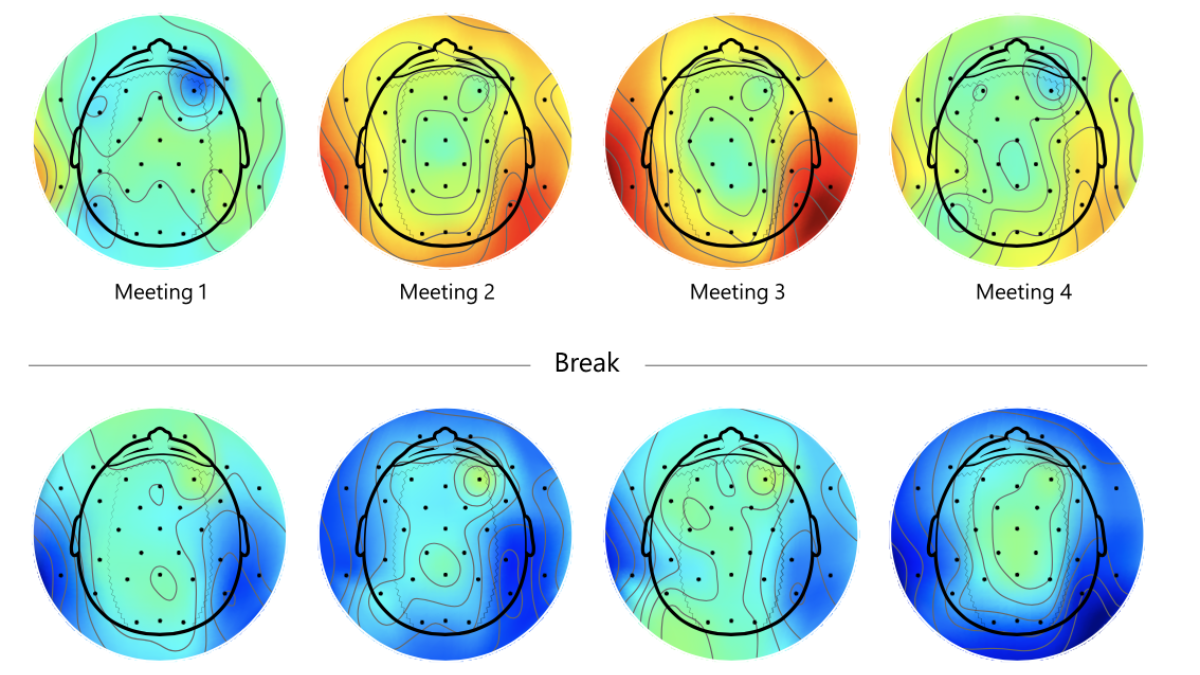
Modern work culture, however, has a pathological allergy to this quiet. We schedule back-to-back meetings, stacking cognitive demands like freight cars on a locomotive. The result is a phenomenon known as “context switching fatigue.” Each new meeting requires your brain to load a new set of rules, emotional tones, and information streams—a process that consumes energy even when the meeting itself is brief. Over the course of a day, the brain accumulates a kind of friction debt. It is not that you worked too hard; it is that you never allowed the brake pads to cool. Studies on cognitive performance consistently show that workers who take even five-minute breaks between meetings report higher clarity and reduced stress. The break is not a rest from work; it is a recalibration of the instrument.
The Unique Appeal of the Deliberate Pause
What makes a break truly effective is not its length but its nature. A “break” that consists of scrolling through Twitter on your phone is not actually a break; it is a different kind of cognitive load, one that fills the void with disjointed stimuli and keeps your DMN locked in a holding pattern. The unique appeal of a true brain break lies in its deliberate emptiness. It might be a three-minute walk around the room. It might be staring at a blank wall. It might be breathing slowly for sixty seconds. The magic ingredient is the absence of external demands. When you allow your brain this space, you are not being unproductive. You are handing the keys of the car over to the subconscious mechanic. You are permitting the myelin sheaths of your neurons to rest and the synaptic gardens to be watered.

A Rhythm for Resilience
The most successful performers—whether athletes, musicians, or scientists—do not grind constantly. They work in cycles of intense focus followed by deliberate recovery. This is the rhythm of nature: the heartbeat that pulses and then rests, the wave that crests and then withdraws. To impose a flat line of constant productivity on your brain is to ask it to function in a way it was never designed to. The next time you feel your concentration fraying, do not fight it. Honor it. Stand up. Walk away. Listen to the quiet. You will return to your desk not with a tired mind, but with the soil freshly turned, ready for new growth.
Leave a comment