


What If Your Productivity System Is Actually the Problem?
Imagine this: you’ve just finished a week where you ticked every box, replied to every email, and cleared your to-do list by Thursday afternoon. You should feel triumphant, a conqueror of time. Instead, you feel hollow, frayed at the edges, and vaguely resentful of the next notification. We’ve all been there, diligently optimizing our workflows until the machine runs so fast it begins to overheat. The sneaking suspicion arrives: what if the very system designed to help you get more done is the thing quietly dismantling your ability to think? This is the high-level conundrum. It’s not about hacking a few extra minutes out of your calendar. It’s about building a framework that doesn’t just process tasks, but protects your cognitive stamina and your will to do the work in the first place. The challenge, then, isn’t speed—it’s sustainability.
The Problem With “More” and “Faster”
Most productivity advice operates on a simple, seductive premise: if you could just be a little more efficient, you’d finally have time for everything. So we chase the latest method—bullet journaling, time-blocking, the Pomodoro Technique—hoping each one is the magic key. Yet these tools often become  elaborate ways to optimize a fundamentally broken strategy. The underlying belief remains: productivity is a numbers game. More inputs equal more outputs. But the human brain is not a binary calculator. It’s an organic system with cycles of focus, fatigue, and renewal. Forcing it into a constant state of high throughput is like redlining a car engine in first gear. You’ll generate a lot of noise, a lot of heat, and eventually, a spectacular breakdown. The high-level framework starts by acknowledging that the quest for “more” is an asymptotic treadmill. You can never outrun your own limits. Instead, we need a paradigm that respects effort as a finite, precious resource.
Define the “Crucible” Before You Light the Fire
A truly high-level framework begins not with your calendar, but with a ruthless, uncomfortable filter. Let’s call it the Crucible Question: “If everything else slipped through the cracks this week, what one or two outcomes would make me feel that the work still mattered?” This is not a gentle prioritization exercise. It’s a surgical strike against the tyranny of the urgent. Most of your daily tasks—the emails, the status updates, the minor revisions—are like paper cuts: individually annoying, cumulatively debilitating. They fill the space that should be reserved for generating real value. A robust framework defines a Primary Output for each week, and perhaps a Secondary Buffer for inevitable interruptions. Everything else is delegated, deferred, or deleted. This isn’t lazy; it’s a form of intellectual triage. When you laser-focus your energy on the few things that truly recalibrate your projects, you stop feeling like a firefighter and start feeling like an architect. The system becomes a protective wall around your best thinking, not a leaky bucket for your scattered attention.
Batching and the Biology of Attention
Our brains are not designed for context-switching. Every time you jump from a deep analytical report to a quick instant message to a creative brainstorm, you pay a steep “switching tax”—losing up to 23 minutes to fully re-engage with the original task. The high-level framework exploits this biological reality. It works not by fighting human nature, but by partnering with it.  This means batching your cognitive modes. Set aside a dedicated 90-minute block (a “deep work fortress”) for the Primary Output—quiet, uninterrupted, in the zone. Then, guard a separate 45-minute block for “shallow work”: correspondence, data entry, approvals. The remaining hours of the day are for meetings, recovery, or spontaneous connection. The key is rigidity. Do not let a single email bleed into your deep work fortress. Do not let a creative idea derail your shallow processing time. By building these temporal containers, you transform chaos into a rhythmic flow. The system becomes predictable, and predictability lowers your baseline anxiety, freeing up the mental energy that was previously spent on “what should I do next?”
The Meta-Framework: Review, Reflect, Recalibrate
No system is self-correcting. The most elegant framework, running on its own momentum, will slowly drift toward entropy. That is why the final—and perhaps most overlooked—component is a periodic, high-level review. At the end of each week, spend fifteen minutes not on the tasks, but on the system itself. Ask yourself: “Did my Primary Output get the attention it deserved? What felt forced? What felt effortless?” This is not about guilt; it is about data. If you consistently failed to protect your deep work fortress, the barrier is too fragile. If your shallow work block overflowed, the volume of that work needs to be renegotiated. 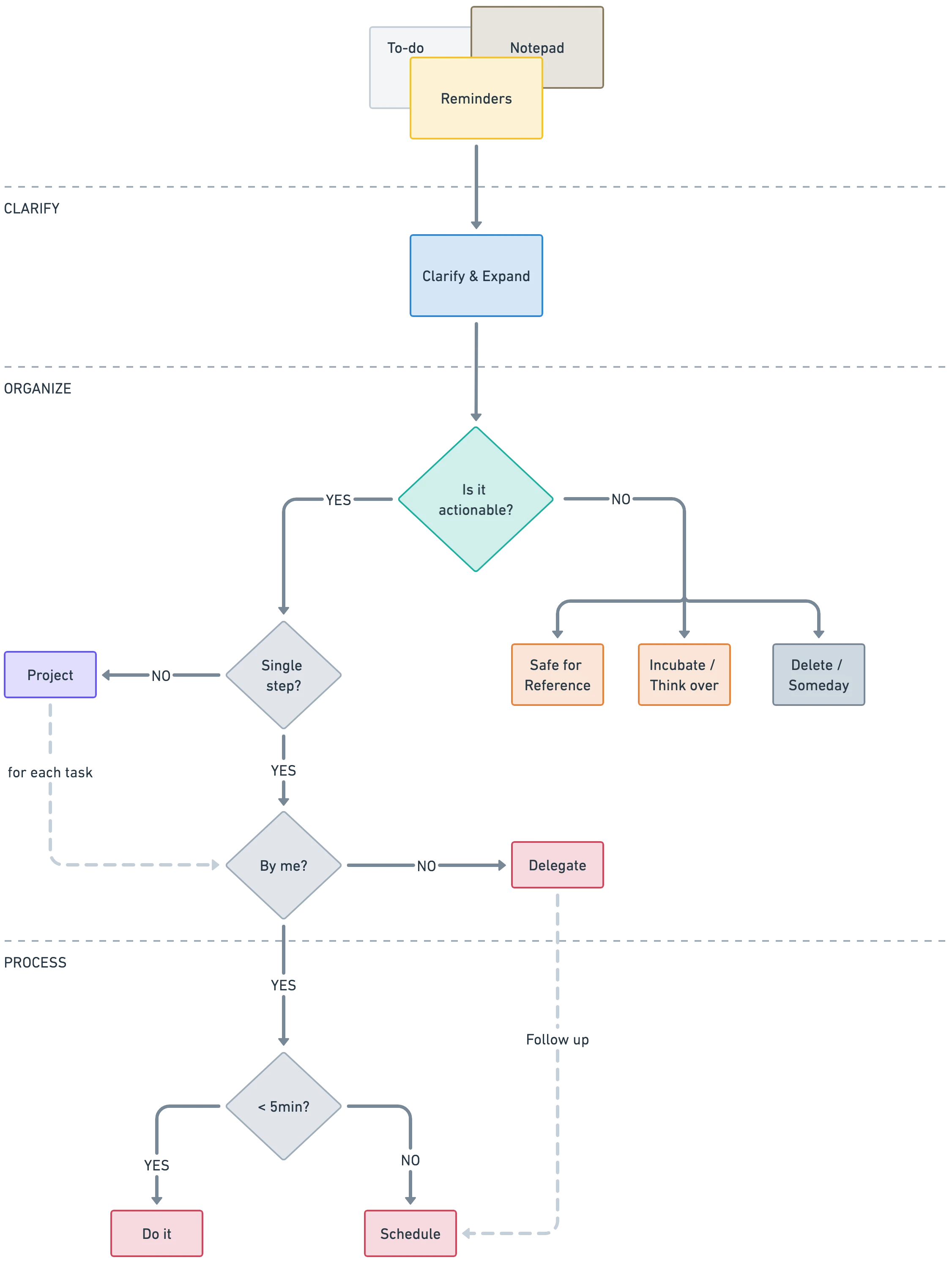 High-level productivity is a living organism. It evolves with your priorities, your energy levels, and the shifting demands of your life. By building in this reflective loop, you transform your framework from a static prison into a fluid, responsive partner. You stop being a slave to the method and become its master. The goal isn’t to grind away until you collapse; it’s to build a rhythm you can sustain indefinitely. The measure of success is not the height of your to-do list, but the depth of your peace at the end of the project.
Leave a comment