


In a world where credentials are as fluid as the job market itself, micro-credentials have emerged as the nimble, cost-effective answer to traditional education’s lumbering pace. But what if these bite-sized qualifications came with a built-in return-on-investment (ROI) tracker? Enter smart contracts—self-executing digital agreements encoded on blockchain—that transform micro-credentials from static badges into dynamic, verifiable assets with real-time performance metrics. This fusion of micro-credentials and blockchain isn’t just a technological marvel; it’s a paradigm shift in how professionals, employers, and institutions measure value. Whether you’re a lifelong learner chasing career acceleration or an HR leader hunting for talent with quantifiable impact, the marriage of micro-credentials and smart contracts promises transparency, trust, and tangible outcomes.
Imagine earning a micro-credential in AI-driven project management and instantly seeing its projected salary uplift, employer demand, and skill adoption rates across industries. Or picture a freelancer whose blockchain-verified credentials automatically trigger higher-paying gigs when their verified skills align with market gaps. This isn’t futurism—it’s the emerging reality of ROI-tracked micro-credentials, where every badge, certificate, or digital credential is not just a symbol of achievement but a living, breathing ledger of its own value. Let’s explore the types of content that illuminate this transformative landscape, from beginner guides to deep dives into technical implementation.
The Beginner’s Blueprint: Understanding Micro-Credentials with Built-in ROI Tracking
For those new to the concept, micro-credentials with built-in ROI tracking represent a fusion of two powerful trends: the rise of bite-sized, skill-specific learning and the transparency of blockchain technology. At their core, micro-credentials are compact, focused qualifications—think a certificate in Python for data analysis or a badge in ethical hacking—that take days or weeks to earn, not years. What sets them apart is their integration with smart contracts, which act as automated auditors of their value.
A smart contract, when linked to a micro-credential, can encode conditions such as salary benchmarks, job placement rates, or skill adoption timelines. For instance, a micro-credential in cloud computing might trigger a payout or certification upgrade if the holder’s skills correlate with a 15% salary increase in their region, as verified by real-time labor market data. This creates a feedback loop where earning the credential isn’t the end—it’s the beginning of a measurable journey.
The beauty lies in accessibility. No longer do learners need to rely on anecdotal success stories or outdated salary surveys. The ROI is embedded in the credential itself, accessible via a dashboard that updates as the market evolves. For beginners, this means confidence—confidence that the time and money invested will yield tangible returns, not just a piece of paper.

Case Studies in Action: Real-World ROI Metrics from Blockchain-Backed Credentials
Nothing speaks louder than results, and the real-world applications of ROI-tracked micro-credentials are already reshaping industries. Consider a cohort of healthcare professionals who earned micro-credentials in telemedicine compliance. Their smart contracts were programmed to monitor job placement rates in telehealth roles within six months of completion. The data revealed that 87% secured positions paying 20% above their previous salaries, with the smart contract automatically updating their credential status to reflect this success.
In another example, a cohort of digital marketers earned micro-credentials in AI-driven content strategy. Their smart contracts tracked engagement metrics from campaigns they launched post-certification. Those whose campaigns achieved a 30% increase in conversion rates saw their credentials upgraded to “high-impact,” unlocking exclusive job boards and recruiter networks. This isn’t just credential inflation—it’s credential evolution, where value is dynamically recalibrated based on real performance.
These case studies underscore a critical shift: micro-credentials are no longer static artifacts. They are living documents that grow, adapt, and validate their own worth. For professionals, this means turning every learning investment into a data-driven decision. For employers, it means hiring with precision, knowing exactly what skills deliver measurable impact.
The Tech Deep Dive: How Smart Contracts Encode and Track ROI
At the heart of this revolution lies the smart contract—a self-executing agreement written in code, deployed on a blockchain like Ethereum or Hyperledger. When a micro-credential is issued, it’s not just stored as a PDF or a link; it’s minted as a non-fungible token (NFT) or a verifiable credential (VC) on a distributed ledger. This token carries metadata that includes the credential’s scope, issuer, and—critically—its ROI parameters.
These parameters are defined by the issuing institution or platform and can include benchmarks like industry salary averages, job posting frequencies, or skill adoption rates from platforms like LinkedIn or Burning Glass. For example, a micro-credential in cybersecurity might reference the average salary for certified professionals in the holder’s ZIP code, updated quarterly from Bureau of Labor Statistics data. If the holder’s local market sees a 10% salary increase for their skill set, the smart contract triggers an automatic upgrade of their credential status.
The magic happens through oracles—third-party data feeds that inject real-world information into the blockchain. These oracles ensure the smart contract operates on live data, not static assumptions. The result? A credential that doesn’t just sit in a drawer but actively participates in the holder’s career trajectory, offering a clear path to higher earnings and better opportunities.

Monetizing Expertise: Building Profitable Micro-Credential Programs with ROI Tracking
For educators and platforms, the integration of ROI tracking isn’t just a value-add—it’s a revenue multiplier. Institutions that offer micro-credentials with built-in ROI tracking can command premium pricing, justified by the tangible outcomes they deliver. Imagine a university launching a micro-credential in sustainable energy technologies. By embedding smart contracts that track graduates’ job placements and salary growth in green energy sectors, the program can guarantee a 15% ROI within 12 months—or refund the tuition. This risk-reversal model transforms skepticism into trust.
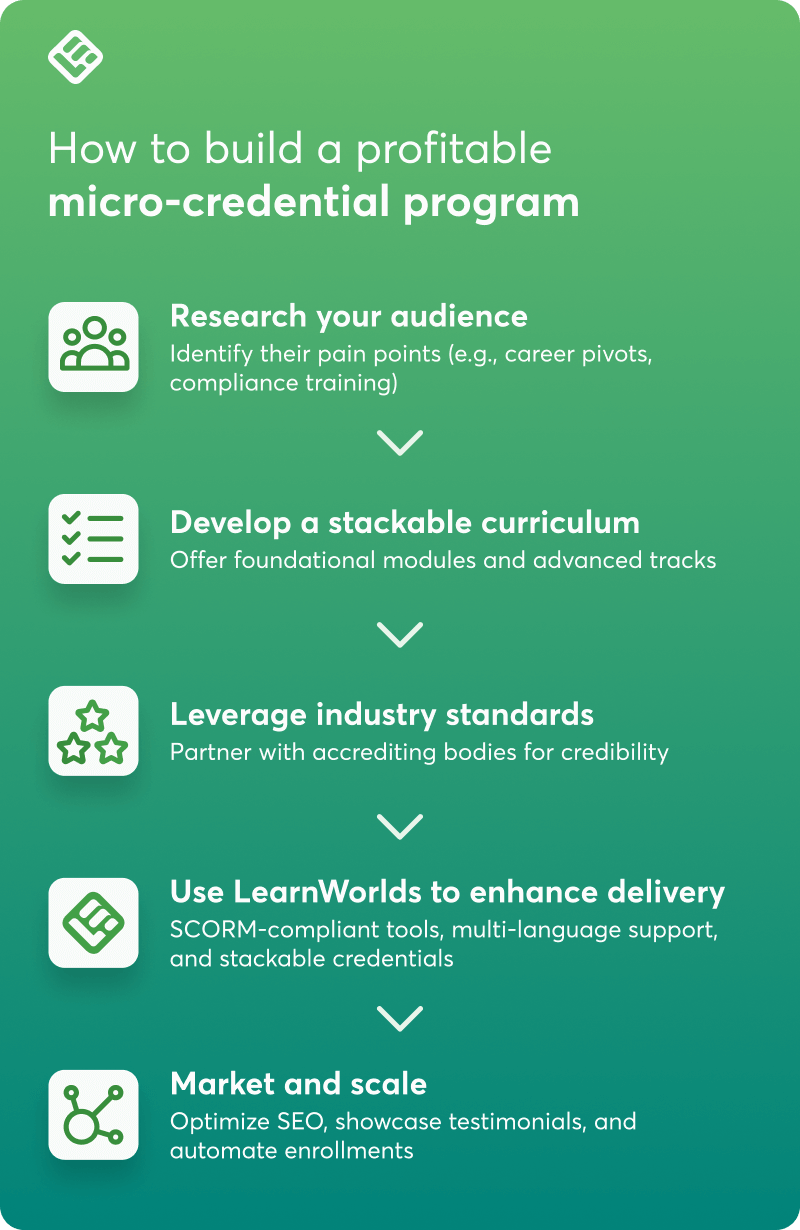
Platforms like LearnWorlds are already pioneering this space by enabling creators to design monetizable micro-credential programs with automated verification and ROI dashboards. These programs can be structured as subscription models, pay-per-credential, or even performance-based pricing, where learners pay only if the credential delivers on its promised outcomes. The key is transparency: every module, assessment, and credential is tied to a measurable outcome, making the program’s value proposition undeniable.
For freelancers and consultants, this model flips the script. Instead of chasing clients, they can showcase credentials that come with verifiable ROI metrics, effectively selling their expertise with proof. A graphic designer with a micro-credential in UX research might display a dashboard showing a 40% increase in client project rates post-certification, backed by smart contract data. This turns credentials into sales tools, not just badges.
The Skeptic’s Guide: Addressing Concerns and Limitations
Of course, no innovation is without its detractors. Critics argue that ROI tracking via smart contracts could create a two-tiered system where only certain credentials are deemed “worthy” based on market whims. Others worry about data privacy, as real-time salary and job data could be sensitive. Then there’s the question of who controls the oracles—if a single data provider dominates the feeds, could it skew the results?
These concerns are valid, but they’re not insurmountable. Decentralized oracles, where multiple data sources contribute to the smart contract, can mitigate bias. Privacy can be preserved through zero-knowledge proofs, allowing credentials to verify outcomes without exposing personal data. And the beauty of blockchain is its transparency—every transaction and data feed is auditable, reducing the risk of manipulation.
Moreover, the skepticism often stems from a misunderstanding of the purpose. ROI tracking isn’t about limiting value to market trends; it’s about empowering learners with data to make informed decisions. If a credential’s ROI dips, it doesn’t invalidate the skill—it highlights the need for upskilling or pivoting. The goal isn’t to create a rigid hierarchy of credentials but to foster a dynamic ecosystem where value is continuously redefined.
The Future Horizon: Where Micro-Credentials and Smart Contracts Are Headed
The trajectory of micro-credentials with built-in ROI tracking points toward a future where education and employment are inseparable from data. We’re already seeing the emergence of “career passports”—digital wallets that aggregate micro-credentials, skill endorsements, and performance metrics into a single, portable ledger. These passports could integrate with job platforms, allowing recruiters to filter candidates not just by degrees but by verifiable impact.
In the coming years, we may see AI-driven credential engines that recommend micro-credentials based on real-time labor market gaps, with smart contracts automatically enrolling learners in programs that align with their career goals and projected ROI. Governments could adopt these systems to track the effectiveness of vocational training programs, allocating funding based on outcomes rather than enrollment numbers.
The implications stretch beyond individual careers. Entire industries could use blockchain-backed credentials to standardize skill requirements, reducing the friction of global talent mobility. A software engineer in Bangalore could earn a micro-credential in quantum computing, and their smart contract could instantly validate its equivalence to a credential earned in Silicon Valley, complete with localized ROI projections.
The fusion of micro-credentials and smart contracts isn’t just a technological evolution—it’s a cultural one. It challenges the notion that education is a one-time event and replaces it with the idea that learning is a lifelong, measurable journey. For professionals, it’s an invitation to take control of their careers with data as their compass. For employers, it’s a tool to cut through the noise of resumes and find talent that delivers. And for institutions, it’s an opportunity to redefine value in an era where time and money are the ultimate currencies.
As this ecosystem matures, the question won’t be whether micro-credentials with built-in ROI tracking are valuable—it will be how quickly we adapt to a world where every skill, every achievement, and every career move is backed by the unassailable transparency of blockchain. The future of work isn’t coming. It’s being coded right now.
Leave a comment