


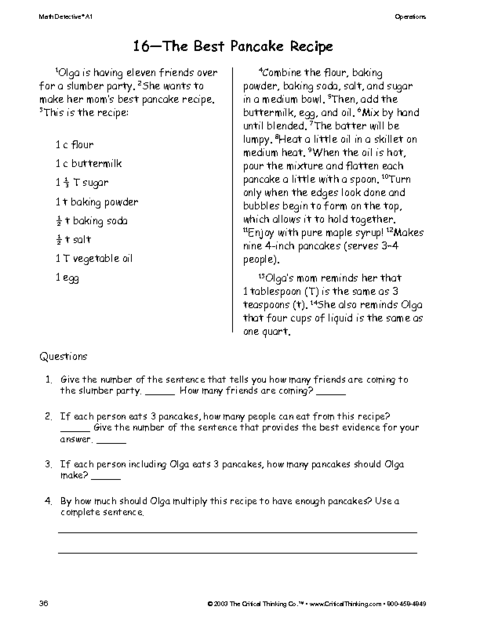
Have you ever stared at a blank worksheet, wondering if the answers were already whispering back at you—from the very pixels of the page? What if the real challenge wasn’t solving the problem, but questioning whether the problem was worth solving in the first place? Welcome to the world of Critical Thinking Worksheets for GenAI Outputs, where students in grades 6 through 12 aren’t just crunching numbers or parsing sentences—they’re interrogating the logic, biases, and hidden assumptions lurking beneath the surface of artificial intelligence-generated content. These aren’t your average fill-in-the-blank drills. They’re cognitive obstacle courses designed to sharpen discernment, cultivate skepticism, and transform passive consumers into active architects of knowledge.
In an era where AI can draft essays, generate code, and even compose poetry, the ability to dissect and evaluate its outputs isn’t just a skill—it’s a survival tool. But here’s the twist: the most effective critical thinking worksheets don’t just present problems; they provoke them. They ask students to play the role of both detective and defendant, to interrogate the very tools meant to assist them. So, buckle up. We’re about to explore how these worksheets can turn classrooms into think tanks, where every answer leads to another question, and every solution births a new challenge.
The Anatomy of a GenAI Output: What Lies Beneath the Surface
Imagine feeding a prompt into a generative AI model—say, “Write a persuasive essay on why homework should be abolished.” Within seconds, a coherent, well-structured response materializes. But pause. What if the essay cites a study from a fringe research group? What if it cherry-picks data to support a one-sided argument? The danger isn’t just in the content; it’s in the illusion of objectivity. Critical thinking worksheets for GenAI outputs begin by dismantling this illusion, teaching students to dissect outputs like forensic analysts.
Start with the basics: source credibility. A worksheet might present a GenAI-generated paragraph alongside a list of potential sources. Students must cross-reference claims with verifiable data, identifying gaps where the AI might have hallucinated or misrepresented facts. Next, examine logical fallacies. Is the argument circular? Does it rely on false dichotomies? A playful prompt like, “Convince me that pineapples belong on pizza—using only AI-generated reasoning,” forces students to spot flawed logic in real time. Finally, dissect tone and bias. Does the AI default to authoritative language when it lacks evidence? Does it amplify stereotypes or subtle prejudices? By breaking down these elements, students learn that GenAI outputs are not neutral—they’re constructed narratives with hidden agendas.

From Consumers to Skeptics: The Role of Questioning in Critical Analysis
Here’s a riddle for you: What’s the one thing GenAI can’t do without human intervention? Answer: ask the right questions. Critical thinking worksheets flip the script by turning students into interrogators. Instead of passively absorbing AI outputs, they’re tasked with crafting inquisitorial prompts that expose weaknesses. For example, a worksheet might present a GenAI-generated summary of a historical event and challenge students to “interview” the AI by posing follow-up questions like, “What primary sources support this claim?” or “How might a different perspective reframe this narrative?”
This approach nurtures epistemic humility—the recognition that knowledge is provisional and that even AI can err. Consider a scenario where students analyze a GenAI-generated biography of a historical figure. They’re asked to identify omissions: Did the AI mention the figure’s controversial policies? Did it gloss over failures? By filling these gaps, students don’t just critique the AI; they reconstruct history with nuance. The lesson? GenAI is a tool, not a truth-teller. And the best way to wield it is with a healthy dose of doubt.
But here’s where it gets interesting: worksheets can also introduce adversarial challenges. Students might be asked to “break” a GenAI model by feeding it absurd or contradictory prompts, then documenting how the AI responds. Does it double down on nonsense? Does it pivot with eerie confidence? These exercises reveal the brittleness of AI systems and underscore the importance of human oversight. After all, if a machine can’t handle a nonsensical question, how can it be trusted with complex ones?
Designing Worksheets That Mirror Real-World AI Dilemmas
Not all critical thinking worksheets are created equal. The most effective ones simulate real-world AI dilemmas, where students grapple with ethical quandaries, logical inconsistencies, and unintended consequences. Take, for instance, a worksheet centered on a GenAI-generated news article about a scientific breakthrough. Students must evaluate the article’s claims, cross-check sources, and assess whether the AI’s summary aligns with the original research. But the twist? The worksheet includes a “red flag” section where students must identify potential biases in the AI’s tone—perhaps it uses overly sensational language or omits key details to fit a narrative.
Another example: a debate-style worksheet where students are split into teams to argue for and against the reliability of a GenAI-generated policy recommendation. One team might defend the AI’s output, citing its efficiency, while the other challenges its assumptions, pointing out gaps in data or logical flaws. This format not only sharpens critical thinking but also hones persuasive communication skills. After all, the ability to articulate why an AI’s output is flawed is just as valuable as spotting the flaw itself.
For a more hands-on approach, consider a “GenAI Audit” worksheet, where students select a piece of AI-generated content—whether it’s a poem, a code snippet, or a marketing pitch—and conduct a thorough audit. They must document the AI’s strengths, weaknesses, and potential biases, then propose improvements. This exercise mirrors the work of AI ethicists and data scientists, giving students a taste of how professionals evaluate AI systems in the wild.
The Hidden Curriculum: Soft Skills for the AI Age
Critical thinking worksheets for GenAI outputs aren’t just about hard skills like logic and analysis—they’re also about cultivating the soft skills that machines can’t replicate. Empathy, for instance, plays a crucial role in evaluating AI-generated content. A worksheet might task students with analyzing a GenAI-written story about a marginalized community. They must ask: Does the AI’s portrayal reinforce stereotypes? Does it center the voices of those affected by the issue? By grappling with these questions, students develop a more nuanced understanding of representation and bias.
Collaboration is another key skill. Worksheets can be designed for group work, where students must collectively evaluate an AI output and present their findings. This mirrors real-world scenarios where teams of experts collaborate to audit AI systems. Students learn to articulate their reasoning, defend their positions, and incorporate feedback—all while navigating the complexities of AI-generated content.
Finally, worksheets can foster metacognition, or the ability to reflect on one’s own thinking. After completing an exercise, students might be asked to write a short reflection on their process: What assumptions did they make? What biases did they uncover? How did their understanding of AI change? This self-awareness is essential in an age where AI is increasingly shaping our perceptions of reality.
Overcoming the Pitfalls: When Worksheets Miss the Mark
Of course, not all critical thinking worksheets are effective. Some fall into the trap of over-simplification, presenting AI outputs as either entirely trustworthy or entirely flawed. Others lack real-world relevance, offering generic exercises that don’t reflect the complexities of GenAI. To avoid these pitfalls, worksheets should:
- Use authentic AI outputs—not sanitized examples, but real GenAI-generated content with its quirks and flaws.
- Encourage open-ended exploration—there’s rarely a single “correct” answer when evaluating AI.
- Incorporate interdisciplinary challenges—link AI outputs to history, science, literature, or ethics to provide context.
- Include self-assessment components—students should reflect on their own biases and limitations as evaluators.
Another challenge is AI literacy. Students need to understand how GenAI models work—at least at a basic level—to evaluate their outputs effectively. Worksheets should include brief explanations of concepts like “prompt engineering,” “hallucinations,” and “bias in training data” to ground their analysis in reality. Without this foundation, students risk misattributing flaws in AI outputs to human error or vice versa.
From Classroom to Career: The Long-Term Impact
The skills honed by critical thinking worksheets for GenAI outputs extend far beyond the classroom. In careers ranging from journalism to software development, professionals must navigate a landscape where AI-generated content is ubiquitous. Journalists must fact-check AI-written articles. Developers must audit AI-generated code for vulnerabilities. Policymakers must evaluate AI-driven recommendations with a critical eye. By practicing these skills early, students are better prepared to thrive in an AI-augmented world.
Moreover, these worksheets cultivate a mindset that’s essential for the future: adaptive skepticism. In a world where AI can generate misinformation at scale, the ability to question, verify, and contextualize information is a superpower. Students who learn to interrogate AI outputs aren’t just better thinkers—they’re more resilient in the face of uncertainty.
So, the next time you encounter a GenAI output—whether it’s a homework assignment, a news article, or a social media post—ask yourself: Is this a tool, or a trick? Is it illuminating, or obscuring? And most importantly, what questions haven’t been asked yet? Critical thinking worksheets for GenAI outputs don’t just teach students to find answers; they teach them to ask the right ones. And in a world where AI is reshaping the boundaries of knowledge, that might be the most valuable lesson of all.
Leave a comment