


What If Your To-Do List Was a Trap?
Imagine, if you will, that your daily schedule is not a roadmap to accomplishment but a cunningly disguised labyrinth, designed not to lead you to the exit but to keep you running in circles. The minotaur in this story? It’s not a mythical beast; it’s the relentless, low-level hum of busyness itself. You check boxes, you reply to emails before your coffee has cooled, you attend meetings that could have been memos—and yet, at sunset, you feel a hollow ache where satisfaction should reside. The challenge, then, is not about doing more. It is about orchestrating a heist on your own time, stealing back the minutes that belong to your deepest priorities. This is the first, often ignored, truth of productivity in a frantic world: the trap isn’t idleness; it’s motion without direction.
The Blueprint’s Foundation: Time as a Non-Renewable Resource
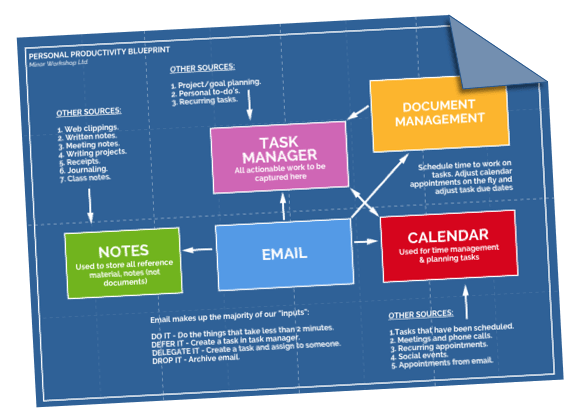
Before you can build a structure for your day, you must accept a hard, gleaming fact: time is the only material that never gets a refund policy. You cannot earn more, borrow it from next Tuesday, or return a wasted hour. This realization is the bedrock upon which any Productivity Blueprint must be laid. Most busy professionals operate as if their time is an elastic band, stretching infinitely to accommodate every demand. It is not. The blueprint, therefore, starts with a ruthless audit. Not just of appointments, but of attention. Where do your ten-minute windows disappear? Perhaps into the black hole of social media scrolling, or the gray zone of “just checking one more thing.” The image below—a stylized blueprint overlaid on a shattered clock—serves as a visceral reminder that every fragment of time you lose is a structural element removed from your day’s foundation.

Deconstructing the “Busy Season” Mindset
There is a dangerous romance to the term “busy season.” It implies a temporary, heroic surge—like firefighters charging into a blaze. But for many, busy season has become a permanent climate, a year-round tropical storm of obligations. The Productivity Blueprint dismantles this myth. Instead of bracing for impact, you build a ship designed for all seas. The first step is to separate genuine urgency from manufactured urgency. That email with a red exclamation mark? It may not be a fire; it might be a spark that can wait an hour. The blueprint asks you to label every task with its true nature: Does it build the future, or just patch the present? For example, a client call to resolve an error is patching. A blocked hour to develop a new system for client onboarding? That is building. The picture below—a dense, complex grid of interconnected tasks—visually represents the chaos of a perpetually busy schedule before any blueprint is applied.
Pockets of Power: Micro-Batching and the 15-Minute Miracle
Conventional wisdom dictates that deep work requires hours of uninterrupted time. This is a luxury that few possess. The blueprint pivots to a more cunning strategy: micro-batching. Instead of one giant block for “write quarterly report,” you break it into three 15-minute sessions. The first session is for data collection. The second is for outlining. The third is for writing the executive summary. This approach exploits a powerful psychological truth: starting is the hardest part. A 15-minute commitment is so small it bypasses your brain’s resistance. It tricks the procrastination monster into thinking, “That’s nothing.” Then, you leverage momentum. The magic occurs when those 15-minute pockets are scheduled ruthlessly—between meetings, while waiting for a download, during that post-lunch slump when your energy dips. The blueprint turns these graveyard shifts of the day into construction sites for your most important work. It is not about having time; it is about claiming the small, sharp edges of it.
Navigating the Fog: Energy Over Hours
A blueprint that only accounts for the clock is a blueprint for exhaustion. The liveliest schedules are built on the foundation of energy, not merely time. Ask yourself a playful but pointed question: Are you a morning lark or a nocturnal owl? Or perhaps a midday cat, most agile after a walk and a good meal? Most productivity systems ignore this, demanding spreadsheet work at 3 PM when your brain has turned to syrup. The Productivity Blueprint maps your energy terrain. It identifies your peak cognitive hours—usually a 90–120 minute window in the morning—and defends them with the ferocity of a lion guarding a kill. No meetings. No email. No interruptions. This is where your hardest, most strategic thinking happens. Then, it aligns lesser tasks—administrative work, routine responses, filing—with your lower-energy slumps. The document below, a classic blueprint-style PDF, represents the structured, almost architectural, approach needed to align energy expenditure with task complexity.
The Ritual of the Shutdown
Perhaps the most radical element of this blueprint is not about what you do during the day, but how you end it. The busiest schedules often breed a soul-crushing open-loop syndrome—where work thoughts buzz in the background of your dinner, your evening walk, and your dreams. The blueprint mandates a shutdown ritual. At a specific time—say, 6:00 PM—you enact a hard close. You write down the one top priority for the next day. You physically close your laptop or turn off your work phone notifications. You engage in a transition activity: a few minutes of stretching, a cup of herbal tea, or simply three deep breaths. This creates a psychological drawbridge. It tells your brain, “The fortress is secure. The work will be here tomorrow. You are now off duty.” This ritual, simple as it sounds, is what separates people who merely survive their busy schedules from those who master them. The blueprint is not a cage for your time; it is the frame for a life that includes both achievement and sanctuary.
Leave a comment