


The Cognitive Biases That Hurt Your Productivity
Imagine your mind as a vast, ancient city, complete with winding alleys, imposing cathedrals of logic, and shadowy shortcuts worn smooth by centuries of use. These shortcuts are not the efficient express lanes you might wish for; they are cognitive biases—mental ruts that promise speed but often deliver you to the wrong destination, taking a heavy toll on your productivity. To work smarter, you must first map this treacherous terrain.
The Spotlight Fallacy: You Are Not the Sun
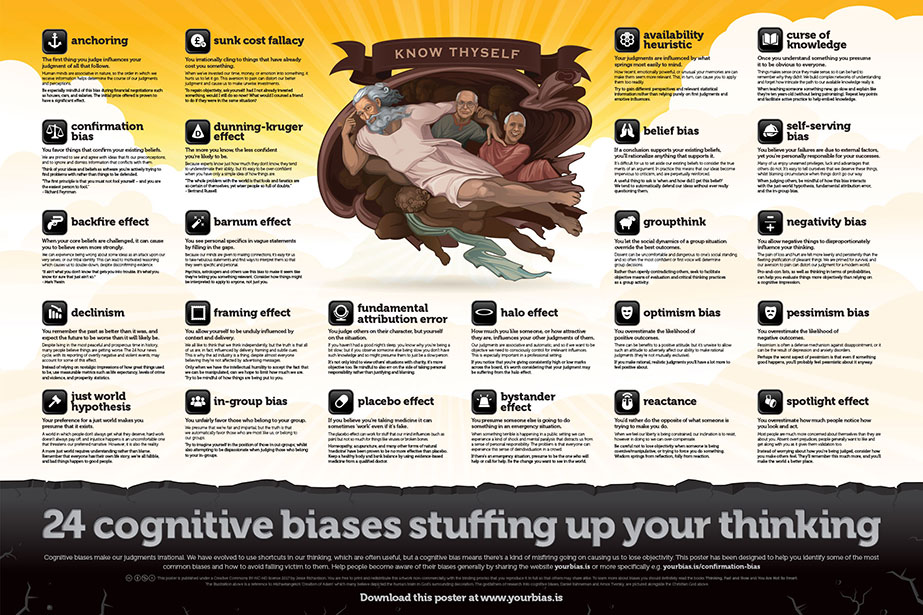
There is a bias that whispers you are the gravitational center of every social interaction, every poorly worded email, every silence in a meeting. This is the Spotlight Effect, and it is a thief of focus. When you believe everyone is scrutinizing your performance, you waste precious cognitive energy on imagined judgment. You polish a single slide for an hour, not because it matters, but because you fear the spotlight’s heat. In reality, your colleagues are trapped in their own spotlights, worrying about their own imperfections. The productive professional learns to dim this imaginary lamp, redirecting that energy from self-conscious editing to meaningful output. The most efficient work happens not under a spotlight, but in a quiet, unobserved workshop.

The Sunk Cost Shipwreck: Anchored to the Wreckage
Few biases chain you more effectively than the Sunk Cost Fallacy. It is the intellectual equivalent of refusing to abandon a sinking ship because you’ve already paid for the tickets. You have invested three hours in a flawed strategy, two weeks in a failing project, or a year in a software system that no longer serves you. Your mind screams, “We’ve come too far to quit!” But the hours are gone. The money is spent. They are sunken costs, resting on the ocean floor. Every minute you waste continuing down the wrong path is a minute stolen from the right one. Productivity demands a ruthless surrender. The most successful individuals are not those who never make mistakes, but those who recognize a sunken cost with clarity and swim toward a new vessel without a backward glance. Do not let past investment dictate future waste.
The Confirmation Echo Chamber: Hearing Only Your Own Voice
Productivity requires truth, yet your brain is wired to prefer comfortable lies. Confirmation Bias is the tendency to seek out information that reinforces what you already believe, and to filter out evidence that challenges your assumptions. You believe your marketing campaign is flawless, so you only read the positive reviews. You assume your workflow is efficient, so you ignore the data suggesting a bottleneck. This bias creates an echo chamber within your own skull, where your own voice grows louder and louder, drowning out the very data that could make you faster, cheaper, or better. To shatter this chamber, you must actively invite dissent. Deliberately read the harsh critique, analyze the failed test, and ask a trusted colleague to tear apart your plan. True breakthroughs occur not when you are affirmed, but when you are discomforted into a better solution.
The Planning Fallacy’s Mirage: The Hourglass That Lies
Consider the most insidious thief of all: the Planning Fallacy. This is the cognitive blind spot that convinces you that you can write that report in two hours (when experience tells you it takes four), that you can finish the website by Friday (when you have never met a deadline without a scramble), that you will be on time (when you are perpetually late). It is not optimism; it is a mirage. You visualize a perfect timeline devoid of interruptions, merging cars, software glitches, or the simple human need for a restroom break. The result is chronic overcommitment and a constant state of emergency. The cure is brutally simple: the reference-class forecast. Instead of asking, “How long will this take *me*?” ask, “How long did it take *people like me* to do *a task like this* in the *real world*?” Multiply your initial estimate by 1.5 or 2. Build a buffer of slack. The productivity gained by under-promising and over-delivering vastly outweighs the hollow thrill of an impossible deadline.
Exit the Labyrinth: The Unique Appeal of Awareness
The unique appeal of understanding these biases is not that you can eliminate them—you cannot. Your brain will always take shortcuts. The appeal is that you can map the labyrinth. You can place a signpost at the Sunk Cost shipwreck, install a mirror in your Confirmation echo chamber, and park a speed bump before the Planning Fallacy mirage. Productivity, in its truest form, is not about working harder or faster. It is about navigating your own cognitive terrain with a wiser, more cautious footstep. Each bias you recognize is a trap you have learned to sidestep. The most productive mind is not the one that thinks the clearest, but the one that understands its own tendency toward murkiness—and plans accordingly.

Leave a comment