


We’ve all been there—staring at a textbook, notes, or a screen, willing our brains to absorb information faster. Yet, no matter how hard we try, some concepts just refuse to stick. What if the secret to learning isn’t about grinding harder, but about working *smarter*? What if the key to rapid comprehension lies not in sheer effort, but in understanding how the brain actually processes and retains information?
This isn’t just another productivity hack. It’s a fundamental shift in how we approach learning—one that leverages cognitive science, neuroscience, and behavioral psychology to help you absorb knowledge with less strain and more efficiency. Let’s explore how to learn faster with less effort, not by cutting corners, but by aligning with how your brain naturally operates.
The Myth of “More Effort = More Learning”
For decades, the prevailing wisdom has been that success in learning is directly proportional to the time and energy invested. Study longer, read more, practice harder—these are the mantras drilled into students from an early age. But anyone who’s crammed for an exam only to forget everything the next week knows this approach has a fatal flaw: it’s unsustainable and often ineffective.
Effort alone doesn’t guarantee retention. In fact, excessive strain can lead to burnout, cognitive overload, and even diminished recall. The brain isn’t a muscle that grows stronger with brute force; it’s a dynamic system that thrives on pattern recognition, repetition, and meaningful engagement. When we push too hard, we trigger stress responses that impair memory formation and reduce our ability to think clearly.
So, what’s the alternative? Instead of forcing more effort, we need to optimize the *type* of effort we apply. This means focusing on strategies that align with how the brain naturally encodes, stores, and retrieves information.
Leverage the Power of Spaced Repetition
Imagine trying to memorize a phone number by repeating it 100 times in one sitting. You might succeed temporarily, but by the next day, it’s gone. Now imagine reviewing that same number once a day for a week. The difference in retention is staggering—and it’s not magic. It’s the principle of spaced repetition, a technique rooted in the forgetting curve, a concept introduced by psychologist Hermann Ebbinghaus in the late 19th century.
Ebbinghaus discovered that we forget information rapidly after learning it, but the rate of forgetting slows down with each review. By spacing out your study sessions—reviewing material just before you’re about to forget it—you reinforce neural pathways, making the information more durable over time. This is why apps like Anki and Quizlet are so effective: they automate the process of scheduling reviews based on your memory decay.
But spaced repetition isn’t just about repetition. It’s about timing. The optimal intervals depend on the complexity of the material and your familiarity with it. For new concepts, reviews might be spaced hours or days apart. For deeper mastery, weeks or even months may be necessary. The key is consistency—not intensity.
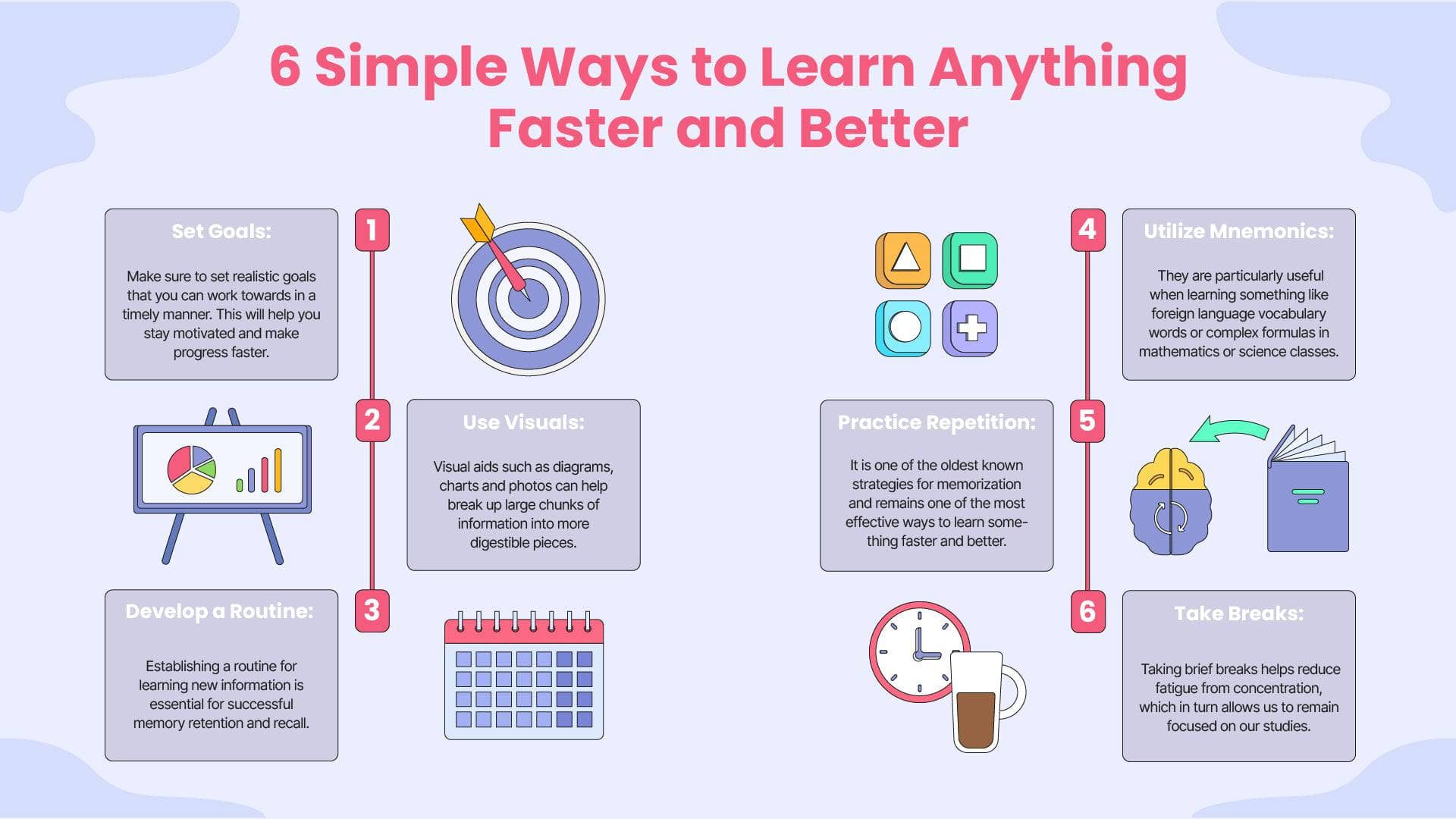
To implement this, break your learning into short, focused sessions (20-30 minutes) and schedule reviews at increasing intervals. Tools like Anki or even a simple calendar can help you stay on track. The result? You’ll retain more with less total study time.
Active Recall: The Brain’s Built-In Efficiency Hack
Passive reading and highlighting might feel productive, but they’re among the least effective ways to learn. Why? Because they don’t engage your brain in the retrieval process—the very mechanism that strengthens memory. Active recall, on the other hand, forces your brain to retrieve information from memory, which not only improves retention but also enhances your ability to apply knowledge in real-world scenarios.
Here’s how it works: Instead of rereading a chapter, close the book and try to recall the key points. Write them down. Teach the concept to an imaginary audience. Use flashcards to quiz yourself. Each time you struggle to retrieve information, your brain marks it as important and reinforces the neural connections associated with it.
Studies have shown that active recall can double or even triple retention rates compared to passive review. It’s like mental weightlifting—your brain gets stronger the more it’s challenged. And the best part? It requires far less time than passive studying.
To integrate active recall into your routine:
- Self-quizzing: After reading a section, pause and summarize it in your own words without looking at the material.
- Flashcards: Use tools like Anki or make your own to test your understanding of key concepts.
- Practice problems: For technical subjects, solve problems without referring to notes first.
- Teach someone else: Explaining a concept aloud forces you to organize your thoughts and identify gaps in your understanding.
Active recall isn’t just a study technique—it’s a mindset shift. It turns learning from a passive consumption of information into an active, engaging process that your brain is wired to excel at.
The Role of Sleep in Accelerated Learning
If you’ve ever pulled an all-nighter before an exam, you know the feeling: exhausted, foggy, and utterly unable to think clearly. Sleep isn’t just a luxury—it’s a biological necessity for learning and memory consolidation. During sleep, your brain processes and integrates new information, strengthening neural connections and pruning irrelevant ones. In fact, studies show that sleep can improve memory retention by up to 30% compared to staying awake.
But sleep isn’t just about quantity; it’s about quality. Deep sleep (slow-wave sleep) is particularly crucial for declarative memory (facts, figures, concepts), while REM sleep plays a key role in procedural memory (skills, habits). Disrupting these cycles—whether through caffeine, irregular sleep schedules, or sleep disorders—can sabotage your learning efforts.
To harness the power of sleep for faster learning:
- Prioritize consistency: Go to bed and wake up at the same time every day, even on weekends.
- Optimize your environment: Keep your bedroom cool, dark, and quiet. Invest in a comfortable mattress and pillows.
- Avoid screens before bed: Blue light from phones and computers suppresses melatonin, the hormone that regulates sleep.
- Nap strategically: A 20-minute power nap can boost alertness and memory consolidation without causing grogginess.
Think of sleep as your brain’s nightly maintenance crew. When you skimp on it, you’re not just tired—you’re actively undermining your ability to learn efficiently.
Interleaving: The Art of Mixing It Up
Most of us fall into the trap of blocked practice—focusing on one topic or skill for an extended period before moving to the next. While this might feel productive, it’s often less effective than interleaving, a technique where you mix different topics or skills within a single study session.
For example, instead of studying math problems A, A, A, A, you might alternate between math, history, and language problems: A, B, C, A, B, C. At first glance, this seems counterintuitive. Why switch between topics when you could master one at a time? The answer lies in how the brain encodes and retrieves information.
Interleaving forces your brain to continuously retrieve and apply different concepts, which strengthens your ability to discriminate between them and recognize patterns. It also mimics real-world scenarios where knowledge isn’t neatly compartmentalized. Studies have shown that interleaving can improve performance by up to 43% compared to blocked practice, particularly in subjects that require problem-solving skills.
To apply interleaving effectively:
- Mix related topics: If you’re learning a language, alternate between vocabulary, grammar, and listening exercises.
- Vary problem types: In math or science, switch between different types of problems rather than solving the same type repeatedly.
- Use real-world examples: Apply concepts from one subject to another. For instance, use statistical analysis from math to interpret data in a psychology study.
Interleaving isn’t just about variety—it’s about building flexibility and adaptability in your thinking. It turns learning from a linear process into a dynamic, interconnected web of knowledge.

Emotion and Memory: Why Stories Stick
Facts and figures are forgettable. Stories, on the other hand, are unforgettable. Why? Because our brains are wired to prioritize emotionally charged information. Emotion acts as a signal to the brain that something is important, triggering the release of neurotransmitters like dopamine and norepinephrine, which enhance memory formation.
This is why mnemonics, analogies, and storytelling are so powerful in learning. They transform abstract information into something vivid, relatable, and emotionally resonant. For example, instead of memorizing a list of historical dates, you might create a narrative that ties them together, making the information easier to recall and harder to forget.
To leverage emotion in your learning:
- Create vivid mental images: Associate new information with striking, unusual, or humorous images. The weirder, the better.
- Use storytelling: Turn facts into a narrative. For example, explain a scientific concept as a journey or a historical event as a drama.
- Connect to personal experiences: Relate new information to something you’ve already experienced. The more personal the connection, the stronger the memory.
- Incorporate humor or surprise: Jokes, puns, and unexpected twists make information more memorable.
Emotion doesn’t just make learning more enjoyable—it makes it more effective. When you engage your emotions, you’re not just storing information; you’re creating a memory that your brain is motivated to retain.
Conclusion: The Effortless Path to Mastery
Learning faster with less effort isn’t about shortcuts or magic bullets. It’s about working with the brain’s natural tendencies rather than against them. By leveraging spaced repetition, active recall, sleep, interleaving, and emotional engagement, you can transform your learning process from a grueling endurance test into a streamlined, efficient, and even enjoyable experience.
The key takeaway? Effort isn’t the enemy—wasted effort is. When you align your study habits with how your brain actually works, you’ll find that mastery comes not from grinding harder, but from working smarter. The next time you sit down to learn something new, ask yourself: Am I doing this in a way that my brain is designed to remember? If not, it’s time to rethink your approach.
Because the most effective learning isn’t the hardest—it’s the smartest.
Leave a comment