


The Quiet Engine of Performance
We often speak of leadership in terms of grand strategy and seismic decisions—the boardroom poker game where the stakes are market share and quarterly earnings. But step back from the whiteboard of corporate myth, and you will find a different truth. The most profound improvements in team output do not arrive via a single, thunderous memo. They seep into the bloodstream of the organization through a far subtler mechanism: the ritual. Not the sterile, calendar-mandated status update, but the living, breathing practice that signals what matters. A leadership ritual is not a meeting; it is a promise. It promises a shift in how attention is paid, how time is valued, and how work is felt. When we stop treating output as a machine-like product of hours and effort, and instead begin to cultivate the rituals that shape how those hours are experienced, we unlock something entirely different. We stop managing production lines and start conducting orchestras.
The Right Kind of Repetition
Most teams are drowning in repetition. Daily stand-ups that have become venting sessions. Weekly reviews that are post-mortems for activities that died days ago. The difference between a ritual that creates output and a habit that drains morale lies in intention. A ritual is a repeated action that carries symbolic weight. Consider the image of a team gathered around a digital whiteboard, tracing a system’s flow—not to fix a bug, but to remember why they build the system in the first place. 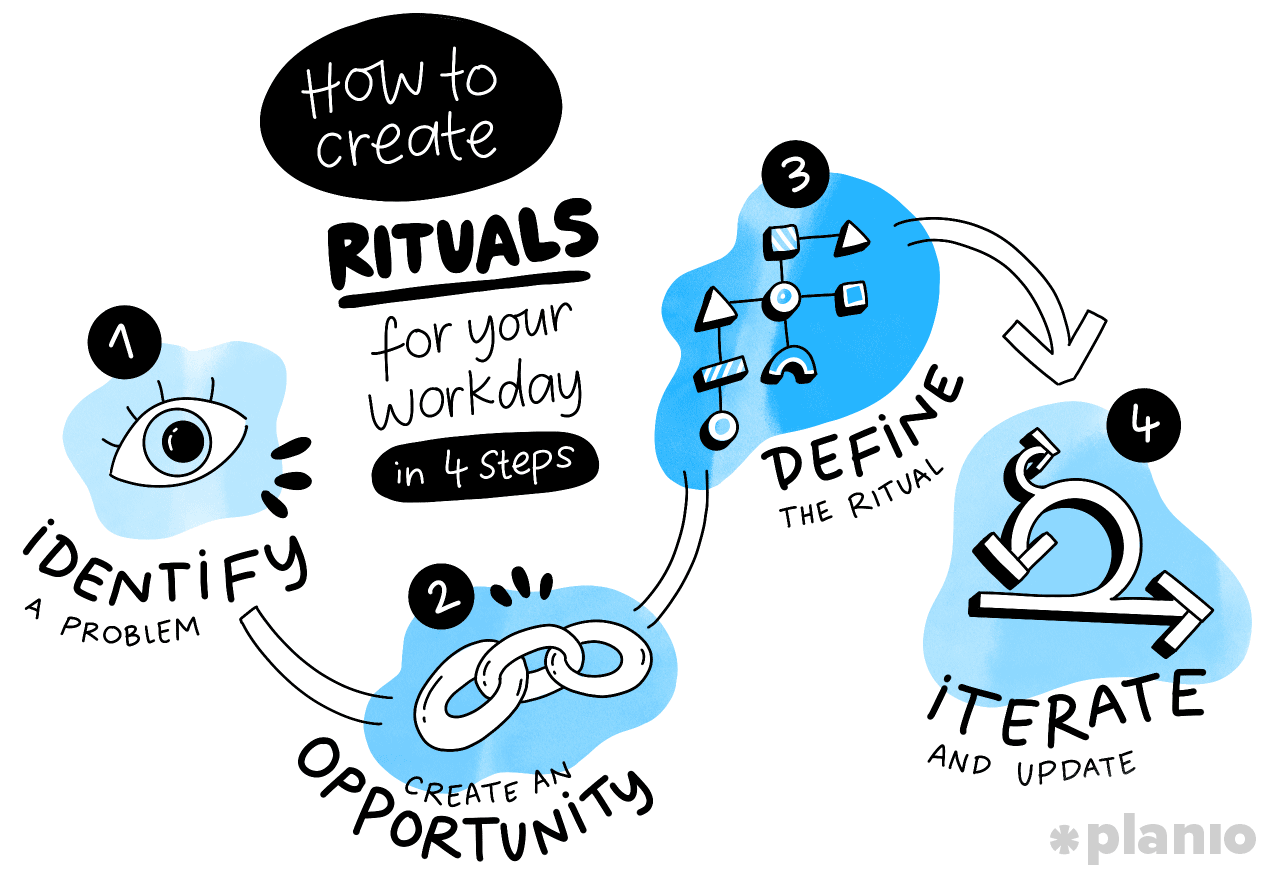 That is a ritual of orientation. It primes the neural pathways of the group for coherence. When you, as a leader, design a ritual that forces a pause—a literal, awkward silence before a decision is made—you are not wasting three seconds. You are engineering a circuit breaker for impulse, a ritual of restraint. Output suffers not because teams are lazy, but because they are reacting. The right ritual injects a pause button into the chaos. It shifts the team from the tyranny of the urgent to the sovereignty of the important.
From Information to Transformation
Data is cheap. Insight is expensive. Most leadership communication is a firehose of information: project updates, risk registers, performance metrics. A ritual, however, transforms information into shared meaning. The most underappreciated high-output ritual is the “learning debrief.” Not a blame post-mortem, but a structured, temporal pause that asks two uncomfortable questions: “What surprised us?” and “What will we do differently?” This is not a performance review; it is a ceremonial act of collective humility. A team that performs this ritual weekly is not just solving problems; they are building a culture that never stops learning.  The output jumps not because they work harder, but because they stop repeating their mistakes with the same conviction. The ritual creates a zero-friction pathway for new knowledge to enter the system. It promises a shift from a culture of “I know” to a culture of “we are curious.” This curiosity is the engine of adaptive output.
The Rhythm of Autonomy and Accountability
High-performing teams walk a knife-edge between freedom and structure. Too much structure, and you kill creativity. Too much freedom, and you get beautiful chaos that never ships. Rituals are the guardrails on this edge. Consider the “weekly intention setting” ritual. It is not a task list. It is a personal contract where each team member states, in one sentence, the single outcome that will define their week. The leader then mirrors this back, not as a command, but as a witnessing. This silent, repeated act creates a gravitational pull. It promises a shift from vague busy-ness to directed effort. The team member feels seen. The leader feels aligned. The output becomes a byproduct of this mutual clarity.  The ritual of shared accountability dismantles the necessity of micromanagement. You do not need to watch them work; you need to watch them commit.
The Unseen Architecture of Trust
Output, in its final form, is a product of psychological safety. A team that fears judgment will produce work that is safe, average, and forgettable. The most sophisticated leadership rituals are those designed to build what sociologists call “social capital.” A simple example: the “first five minutes” ritual at the beginning of a critical project review. Instead of diving into the data, the leader asks each person one human question: “What do you need from this group to do your best work today?” This is not therapy; it is operational intelligence. It signals that the person is more important than the spreadsheet. The ritual of beginning a high-stakes conversation with a connection-first posture rewires the team’s nervous system from fight-or-flight to cooperative problem-solving. The output that follows is not just faster; it is more innovative, more resilient, and more sustainable. It is the difference between a ship crew that follows orders and a crew that anticipates the storm.
The Ritual as a Living Signature
Ultimately, the leadership rituals that improve team output are not about the activities themselves. They are signatures of your leadership philosophy. They are the proof of your promises. A team will not believe your mission statement. They will believe what happens every Monday at 9 AM. They will trust the silence you hold after a difficult decision. They will be shaped by the way you end a meeting—not with a tired “okay, let’s move on,” but with a deliberate circle that asks, “What is our one key takeaway from this hour?” That final moment is a ritual of closure and clarity. It seals the output of the conversation into a concrete artifact. When you master these invisible structures, you stop leading by command and start leading by compulsion. You create a gravitational field that naturally draws the team toward their best output, not because you forced them, but because the ritual made it inevitable. The shift in perspective you promised them has become the air they breathe. That is the only leadership metric that matters.
Leave a comment