


The Glittering Trap: When High Standards Become a Cage
There is a particular species of productivity advice that, on its surface, seems unimpeachable. It whispers of “polishing your craft,” “raising the bar,” and “delivering impeccable work.” The allure is undeniable. To be a perfectionist is to be cast as a dedicated artist, a relentless seeker of excellence in a world content with mediocrity. But the relationship many of us have with perfectionism is far more nuanced—and far more damning—than a simple drive for quality. It is a sophisticated form of self-sabotage, a cognitive loop that masquerades as virtue while systematically draining our momentum.
We observe it in the colleague who endlessly revises a presentation until the deadline passes, or in ourselves when we abandon a project because a single paragraph doesn’t “feel right.” The common observation is that the perfectionist never finishes. But the deeper, more fascinating reason lies not in a love of quality, but in a profound fear of judgment. The quest for perfection is rarely about making something good; it is about ensuring that no one can ever find fault. And that, in the economy of creative and professional output, is the fastest route to paralysis.

The Neuroscience of “Not Yet”: Why Your Brain Prefers the Empty Page
The moment a new idea sparks, it exists in a state of pure potential. It is flawless because it has no form. This is a deeply comfortable state for the brain. The dopamine hit from imagining a perfect outcome is immediate and untethered from the messy reality of execution. As soon as you type the first sentence, sketch the first line, or record the first take, you introduce asymmetry. The gap between the vision in your head and the imperfection on the screen becomes a source of palpable anxiety.
This is where the perfectionist’s productivity dies. The brain, wired to avoid pain, interprets this gap as a threat. Instead of working through the “ugly first draft” phase—which is universally recognized as necessary by every productive creator—the perfectionist retreats. They conduct more research. They reorganize their tools. They polish a non-existent product. This isn’t laziness; it is a sophisticated form of procrastination fueled by a reward system that craves the safety of the imagined, rather than the reality of the actual.
The result is a cycle of diminished output. Every time you leave a task unfinished because it failed to meet an internal, often arbitrary, standard, you reinforce the neural pathway that says, “It is safer to not finish than to finish and be judged.” Over months and years, this transforms a person from a creator into a ruminator—someone who is brilliant in theory but utterly inert in practice.
Iteration Over Inflation: The Mathematics of the Done
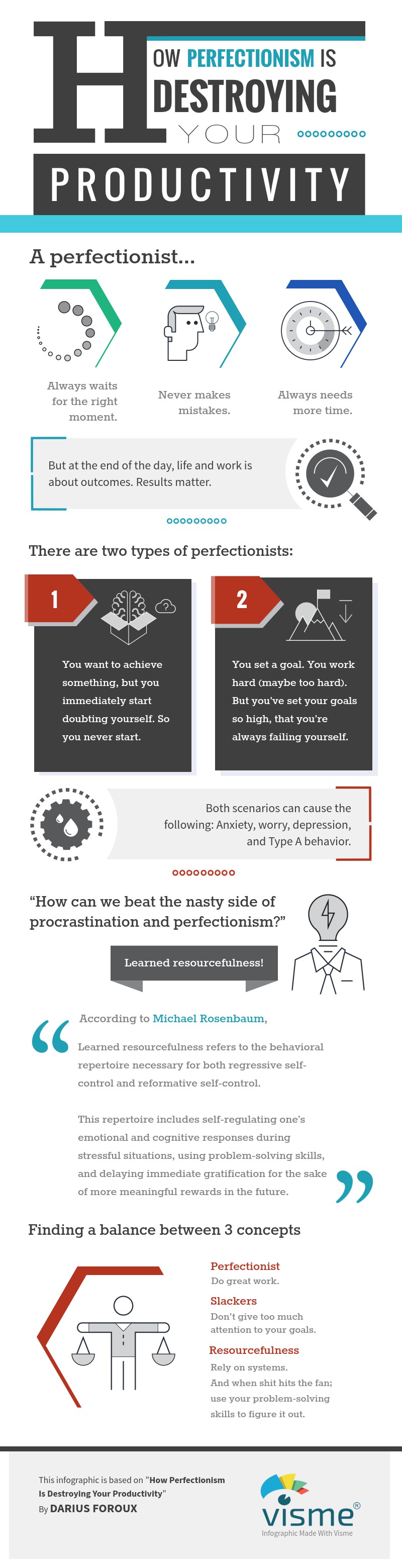
Many productivity systems fail because they try to manage time. To defeat perfectionism, you must first understand the physics of value creation. Consider two writers: the Perfectionist and the Iterationist. The Perfectionist spends one month writing a single article, refining every comma and adjective until it gleams. The piece is a masterpiece of prose. The Iterationist spends that same month writing thirty pieces. Each is flawed. A few have typos. One has a weak thesis. However, by the end of the month, the Iterationist has produced thirty data points. They know which topics resonate. They have practiced their craft thirty times. They have gathered thirty opportunities for feedback.
The Perfectionist, in contrast, has one data point, and the cost of that perfection is the loss of learning velocity. This is the core of why perfectionism kills productivity: it replaces the volume of iteration with the inflation of a single unit. In a complex world, no amount of isolated perfection can compete with the compound interest of repeated, imperfect action. The “perfect” article is worthless if it is never published. The “perfect” design is worthless if it never ships. The market, the audience, and the world do not reward perfection; they reward presence and improvement.
Deconstructing the Fear: What You’re Actually Protecting
To break the spell, we must address the core emotional payload: the fear that a flawed output reveals a flawed self. Perfectionism is a fortress built to protect a fragile identity. “If I produce something flawless,” the logic goes, “then I am flawless.” The vulnerability of error is so terrifying that the perfectionist chooses invisibility over risk. They would rather be known for nothing than be known for something imperfect.
This is a deeply understandable, yet catastrophic, trade-off. Productivity is not a measure of the quality of your finished products; it is the rate at which you convert potential into reality. Every hour spent polishing a sentence to a mirror shine, when a “good enough” version would suffice, is an hour stolen from the next project. Every email that goes unsent because you can’t find the perfect closing remark is a relationship left unbuilt. To reclaim your productivity, you must first accept a radical premise: your work will always be incomplete, and that is its greatest strength. An imperfect creation is a living thing. It invites collaboration, iteration, and growth. A perfect creation is a dead thing, sealed in a glass case, admired but untouchable.

Prescription Over Prevention: The Rituals of the Imperfect
Overcoming perfectionism is not about lowering your standards; it is about changing your relationship with outcomes. The most powerful tool for this is the “deliberate imperfect.” Set a timer. Give yourself twenty minutes to write a terrible paragraph. Or design an intentionally ugly prototype. The goal is to desensitize your brain to the discomfort of incompleteness. When you prove to yourself that the world does not end when you produce something flawed, the fear loses its grip.
Another ritual is the “shipping deadline.” Choose a date and a time, and commit that whatever you have at that moment is the final version. You are not allowed to change it. This forces the brain to accept “good enough” as a valid finish line. You will almost always find that what you produced was not only passable, but often surprisingly effective. The energy you wasted worrying about the missing details was the very energy you needed to produce the next piece of work.
Ultimately, the fight against perfectionism is a fight for volume, for momentum, and for the strange, beautiful liberation that comes from letting the world see you mid-process, ink still wet, edges still rough. Your biggest productivity killer is not a lack of skill, but the desperate desire for a flawless debut. The cure is simple, if terrifying: publish before you are ready. Iterate in public. And watch how quickly the cage door swings open.
Leave a comment