


The Gilded Cage of Consistency
We fetishize the grind. We celebrate the athlete who trains through a storm, the executive who works through a fever, the artist who polishes the same stroke until the canvas bleeds. This is the myth of peak performance: a straight, unbroken line upward, carved from sheer will. But every high-performance engine eventually throws a rod not from excessive speed, but from a tiny, undetected vibration. The real saboteur of your potential isn’t laziness or lack of talent. It is the silent, creeping error you commit every single day—the mistake you never notice because it feels exactly like ambition.
Consider the gaussian distribution of effort. Most people live in the fat middle, oscillating between mediocre and average. A few, the so-called “high achievers,” push into the right tail of the curve. But here is the paradox: the very discipline that propels you into that tail also sets the trap. The mistake isn’t that you work hard. The mistake is that you confuse activity with adaptation. You mistake the exhaustion of the rep for the growth of the muscle. This is the Gilded Cage of Consistency—where you are so perfectly consistent in your routine that your body and mind stop being challenged and start being merely endured.

The Invisible Tax of Efficiency
Efficiency is a seductive liar. It whispers that the best path is the shortest path, the most economical use of energy. In the short term, this is true. But in the long arc of high performance, efficiency is often the enemy of resilience. The brain, like the body, is a lazy organ. It will always seek the path of least resistance. When you repeat the same presentation, the same workout, the same coding pattern, your neural pathways myelinate. You get faster. You get smoother. You look brilliant.
What you don’t see is the tax. You are paying for that smoothness with variability. Your system is no longer agile. It has become a silk-lined trap. The moment a variable shifts—a new competitor, a different stressor, an unexpected injury—your optimized system shatters. The peak performer makes the mistake of optimizing for the known world. The true master optimizes for the unknown. They deliberately introduce friction. They practice with a limp. They write with their non-dominant hand. They break the beautiful machine just to see if they can rebuild it under duress.
This is the Invisible Tax of Efficiency: the quiet decay of your ability to handle surprise. You don’t feel it because you are winning. But when the ground shifts, you will find you have built a palace on sand.
The Myth of the “Flow State” Trap
Flow is the holy grail. That effortless state where time dissolves and action merges with awareness. But the most pernicious mistake high performers make is trying to live in flow. They read books by Csikszentmihalyi. They optimize their workspace for deep work. They chase the dopamine of effortless genius. And this is precisely where they fail.
Flow is not a habitat; it is a reward. It is the brief summit after a long, deliberate, and often uncomfortable climb. The mistake is believing that you can set up camp on the summit. You cannot. The pressure to stay in flow creates a deep, unconscious anxiety. You start avoiding the hard, ugly, preparatory work because it feels “clunky.” You judge your own process as “not good enough” because it lacks the smooth grace of peak performance. You are essentially criticizing a caterpillar for not being a butterfly.
The unnoticed mistake here is the fear of the liminal state—that awkward, frustrating, disoriented feeling just before a breakthrough. The true peak performer does not fear the mud. They recognize that the mud is the only path to the summit. They do not mistake the feeling of disorientation for the failure of direction.
The Silent Erosion of “Para-Performance” Habits
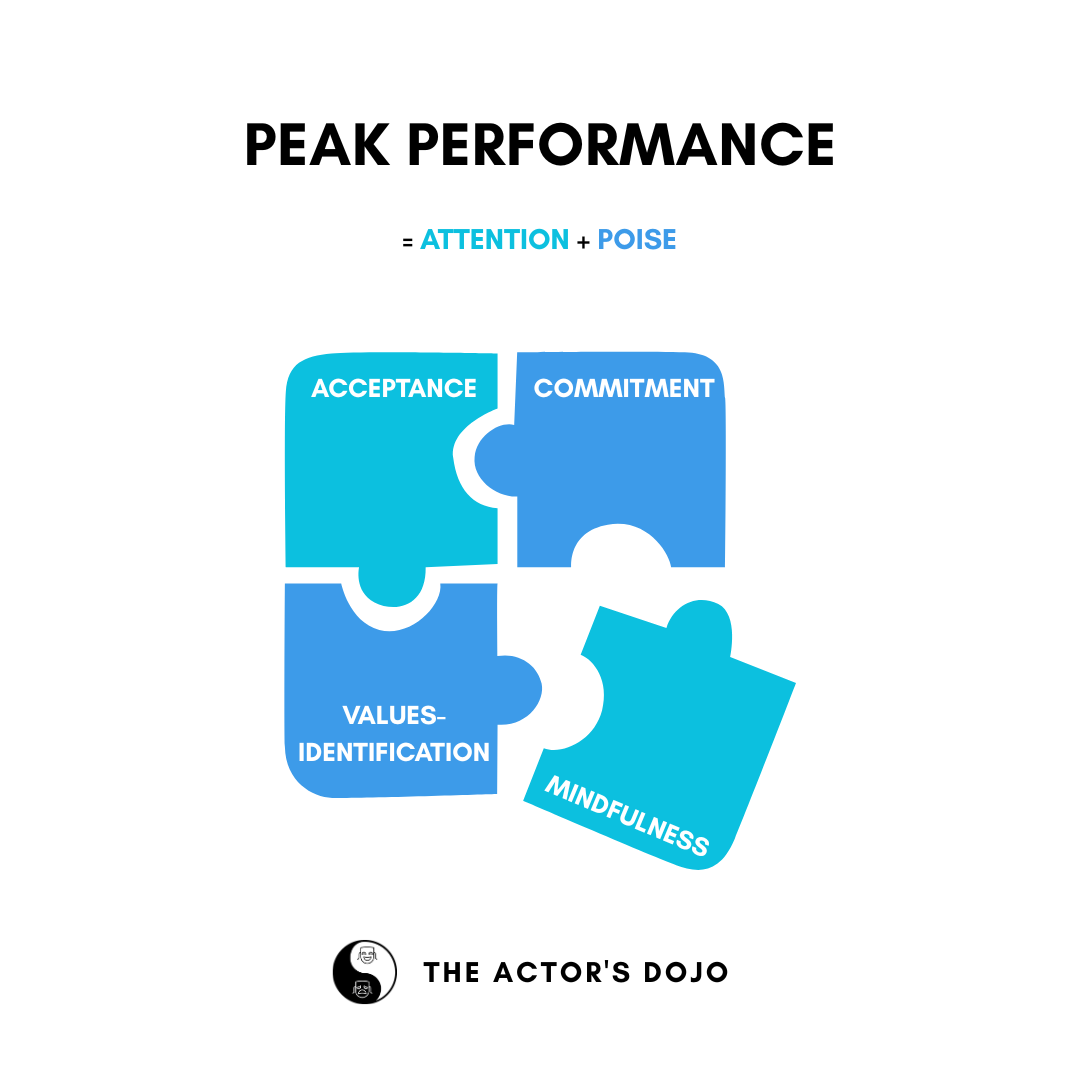
Look at the image above. The puzzle is almost complete. One piece is missing. That missing piece is not the big event. It is not the keynote speech, the championship game, or the quarterly report. That missing piece is the invisible architecture of recovery, nutrition, sleep, and emotional hygiene. We call these “supporting” habits. We treat them as secondary. This is the grand mistake.
I call them para-performance habits—those actions that exist around the performance. The five-minute meditation after the stressful meeting. The 20-minute walk after a long coding session. The glass of water before the coffee. The decision to stay silent for five seconds before responding to criticism. These tiny, almost negligible micro-choices are not optional. They are the load-bearing walls of your peak state.
The mistake is that you ignore them because they lack a reward. You get no dopamine spike from drinking water. You get no social validation for taking a nap. So you skip them. You “power through.” And over years, this erosion is absolute. Your reaction time slows by 200 milliseconds. Your emotional regulation blunts by one degree. Your cognitive flexibility drops by 5%. You don’t notice the decline because it is a slow, glacial slide. You just think you are getting older or more tired. In truth, you are simply ignoring the mortgage payments on your own performance.
To fix this, you must treat the periphery as the center. You must assign as much strategic importance to your off-stage rituals as you do to your on-stage work. A peak performer who sleeps six hours and skips breakfast is not disciplined; they are working against compound interest.
The Bravery of the Deliberate Pause
The ultimate overlooked mistake is the refusal to stop. Not to rest—rest is just delayed work. I mean to truly, radically stop. To look at the engine while it is running and ask, “Is this still the right race?” The culture of peak performance is addicted to momentum. We believe that if we stop, we will fall behind. We believe that momentum is sacred.
It is not. Momentum is just inertia in a nice suit. The most courageous act of a high performer is not the sprint to the finish; it is the decision to pause, mid-stride, and change the path entirely. This requires a brutal honesty that most cannot summon. It means admitting that the path that brought you here is not the path that will take you there. It means burning the map you have so carefully drawn.
The mistake is thinking that peak performance is a linear journey. It is not. It is a series of deep, recursive loops. You climb, you plateau, you descend, you reorient, you climb again. The ones who win are not the ones who never stumble. They are the ones who notice the stumble in the first step, who recognize the error in the rhythm, who have the grace to stop dancing long enough to hear the new song. That is the peak performance mistake you never notice: refusing to listen.

Leave a comment