


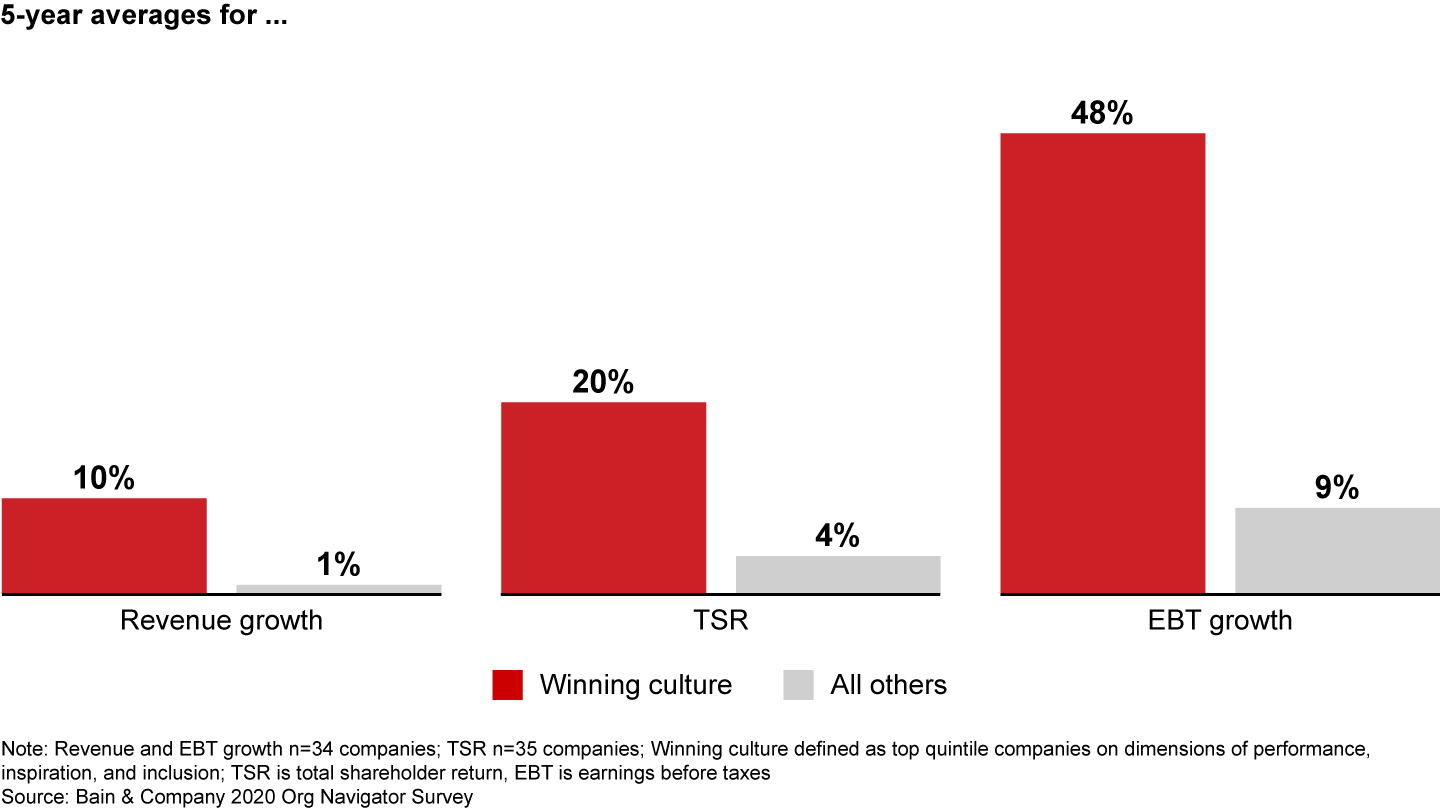
Most organizations chase high performance like a mirage—always visible, never quite within reach. They throw money at training programs, stack on incentives, and demand more from their teams, only to watch motivation fizzle and results plateau. But what if the secret to high performance isn’t in the tools or the tactics, but in the very fabric of how people think, collaborate, and commit? What if building a high-performance culture isn’t about pushing harder, but about creating a space where excellence becomes inevitable?
Ajarn Forum Latest Articles
How to Build a Future‑Focused Productivity System

We all know the feeling: the inbox overflows, meetings multiply, and by the time we sit down to work, the day is already half gone. Yet, despite our best efforts, productivity often feels like chasing a moving target. The irony? We’re drowning in tools and advice, yet starving for clarity. What if the solution isn’t more apps or stricter schedules, but a system designed for the future—one that anticipates chaos instead of reacting to it?
The Communication Mistakes That Kill Productivity


The Communication Mistakes That Kill Productivity
The Fog of Ambiguity: When Clarity Becomes a Casualty
In the relentless machinery of modern business, productivity is the axle around which everything spins. Yet, the most common grease for that axle is effective communication—and conversely, its failure is the grit that grinds the gears to a halt. The most insidious mistake is not outright silence, but the pervasive fog of ambiguity. When a manager gives directions that are half-formed, or a colleague asks for “the report soon,” they are not communicating; they are seeding confusion. Each team member interprets “soon” differently—one thinks before lunch, another by Friday. This misalignment creates a cascade of wasted effort. The employee who expedites the task may find their work shelved, while the one who delayed may miss a critical window. The result is a double loss: the time spent on the wrong priority, and the subsequent time spent correcting course. In a high-stakes environment, ambiguity is not merely a nuisance; it is a budgeter of hours spent on fruitless labor. The antidote is radical specificity: dates, times, measurable outcomes, and explicit ownership. Without it, productivity is not just diminished—it is systematically dismantled.
The Productivity Blueprint for Busy Schedules
What If Your To-Do List Was a Trap?
Imagine, if you will, that your daily schedule is not a roadmap to accomplishment but a cunningly disguised labyrinth, designed not to lead you to the exit but to keep you running in circles. The minotaur in this story? It’s not a mythical beast; it’s the relentless, low-level hum of busyness itself. You check boxes, you reply to emails before your coffee has cooled, you attend meetings that could have been memos—and yet, at sunset, you feel a hollow ache where satisfaction should reside. The challenge, then, is not about doing more. It is about orchestrating a heist on your own time, stealing back the minutes that belong to your deepest priorities. This is the first, often ignored, truth of productivity in a frantic world: the trap isn’t idleness; it’s motion without direction.
How to Build a Life That Elevates Your Standards

What if the life you’re living today is just a draft—an unpolished version of what you’re truly capable of? What if, by simply raising your standards, you could transform the ordinary into the extraordinary? The truth is, most people settle for less because they’ve never been taught how to demand more—not from others, but from themselves.
The Systems Blueprint for Long‑Term Success

The Silent Engine of Achievement
Success, in its most enduring form, is not a destination but a state of operation. It is rarely the product of a single heroic sprint; rather, it emerges from the steady, quiet hum of a well-designed engine. Most people chase the flashy dashboard lights of victory—the revenue spike, the viral moment, the public accolade—while ignoring the pistons and valves beneath the hood. The true architect of longevity understands that the visible outcome is merely the exhaust. The real work, the only work that matters, occurs within the systems. These are the silent engines that turn chaotic effort into predictable momentum. To build for a decade, not a quarter, one must stop fixating on the what and start obsessing over the how and the why. The Systems Blueprint is that architectural plan, a map of gears and levers designed to convert intention into consistent, compounding results.
The Resilience System That Never Fails

The Paradox of Perpetual Integrity
We are obsessed with the unbreakable. We chase the indestructible lock, the bulletproof glass, the guarantee that never expires. Yet the most profound truth of resilience is this: a system that never fails is a system that has already died. It is a corpse, perfectly preserved in amber, incapable of adaptation. The genuine resilience system—the one that never truly fails—does not avoid fracture. It dances with it. It metabolizes collapse. It treats every failure as a necessary evolutionary subroutine, a message written in the bone of impact. This is the architecture not of a fortress, but of a forest. And it is the only architecture that can survive the coming storm.
The Creative Planning System You Need

The Architecture of Intentionality
We are drowning in a sea of digital noise, yet starving for meaningful progress. The modern professional’s desk is a battlefield—littered with sticky notes, half-filled to-do lists, and browser tabs that whisper conflicting priorities. This is not a failure of discipline; it is a failure of system. The creative planning system you need is not a rigid cage for your thoughts, but a scaffold for your imagination. It must be as fluid as a brainstorming session yet as structured as a flight plan. This article explores the different types of content—visual, textual, and strategic—that form the backbone of such a system, guiding you from chaotic inspiration to deliberate execution.
The Motivation Mistakes That Kill Progress

The Allure of False Fuel
Motivation is a seductive beast. We chase its high, believing that a surge of inspiration is the master key to unlocking productivity, discipline, and lasting progress. Yet, for all its initial brilliance, motivation is a notoriously fickle fuel. It burns hot and fast, leaving us stranded in the cold when the initial rush fades. The most pernicious mistakes we make are not failures of will, but failures of strategy—a series of cognitive traps that promise motion but deliver stagnation. We mistake the feeling of readiness for the act of doing, and in doing so, we sabotage the very progress we seek.
The Best Tools for Productive Studying

The Best Tools for Productive Studying
There is a peculiar magnetism to the empty desk. The clean page. The freshly sharpened pencil. It promises order in a chaotic mind. Yet, for most students, this pristine moment dissolves within minutes—a notification pings, a thought wanders, a spine slumps. The tools we choose to study with are not mere accessories; they are scaffolds that either hold our focus aloft or crumble beneath its weight. The fascination with productivity tools isn’t just about getting more done. It is about the quiet battle against entropy, the attempt to corral the scattered self into a coherent, purposeful flow. The right instruments do not just speed up work—they reshape the psychology of the learner.